Product Pricing
Unit 1: Market - Meaning and Types
1.1 Definition of Market
A market is an arrangement where buyers and sellers exchange goods and services at an agreed price.
1.2 Types of Markets
A. Based on Geographical Area:
TypeMeaningExampleLocal MarketLimited to a small area, perishable goodsVegetables, milk, fishNational MarketWithin one country, transportable goodsRice, wheat, clothesInternational MarketAcross countries, valuable goodsTea, coffee, machinery
B. Based on Commodities:
TypeMeaningExampleCommodity MarketGoods marketRice market, cloth marketFactor MarketFactors of production marketLabour market, capital market
C. Based on Time:
TypeMeaningVery Short PeriodSupply fixed (daily market)Short PeriodCan adjust some factorsLong PeriodCan adjust all factors
Unit 2: Perfect Competition Market
2.1 Definition
Perfect Competition is a market structure with:
- Many buyers and sellers
- Homogeneous products
- Free entry and exit
- Perfect information
- Price takers (firms accept market price)
2.2 Characteristics
- Large number of buyers/sellers – No single firm affects price
- Homogeneous product – Identical goods from all sellers
- Free entry and exit – No barriers
- Perfect knowledge – All know prices and quality
- Perfect mobility – Factors move freely
- No government intervention – Price determined by demand-supply
2.3 Price Determination in Perfect Competition
Price is determined where market demand = market supply.
Table: Demand-Supply Schedule
Price (Rs.)Quantity DemandedQuantity SuppliedMarket Condition1020050Shortage (Excess Demand)20150100Shortage30100100Equilibrium4050150Surplus (Excess Supply)5025200Surplus
Diagram:
text
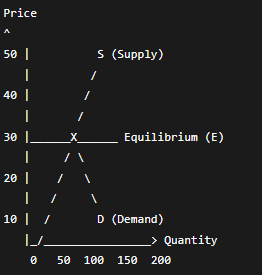
Equilibrium Price: Rs. 30
Equilibrium Quantity: 100 units
E = Equilibrium point (Demand = Supply)
Unit 3: Monopoly Market
3.1 Definition
Monopoly is a market structure with:
- Single seller
- No close substitutes
- Barriers to entry
- Price maker (sets own price)
3.2 Characteristics
- Single seller – Only one firm controls market
- No close substitutes – Unique product
- Barriers to entry – Others cannot enter
- Price maker – Sets price to maximize profit
- Downward sloping demand curve – Must lower price to sell more
3.3 Price Determination in Monopoly
Monopolist sets price where MR = MC (Marginal Revenue = Marginal Cost).
Diagram:
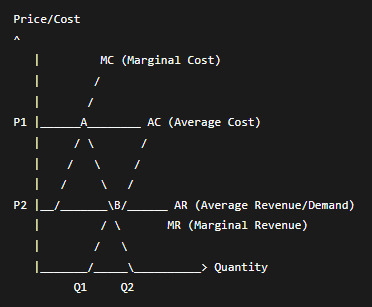
Equilibrium: Point A (MR = MC)
Price: P1 (from demand curve)
Quantity: Q1
Profit: Area (P1-AC at Q1) × Q1
Unit 4: Comparison of Markets
4.1 Perfect Competition vs Monopoly
BasisPerfect CompetitionMonopolyNumber of sellersManyOneProductHomogeneousUniqueEntry/ExitFreeRestrictedPrice controlPrice takerPrice makerDemand curveHorizontal (elastic)Downward slopingProfitNormal in long runCan be supernormalEfficiencyMore efficientLess efficient
4.2 Real World Examples
Perfect Competition:
Agricultural markets (rice, wheat)
Stock exchange
Monopoly:
Nepal Electricity Authority (NEA)
Nepal Oil Corporation (NOC)
Patented medicines
Key Terms & Definitions
Market: Place/arrangement for buying-selling.
Equilibrium Price: Price where demand = supply.
Price Taker: Firm accepting market price (perfect competition).
Price Maker: Firm setting own price (monopoly).
Homogeneous Product: Identical goods from all sellers.
Barriers to Entry: Obstacles preventing new firms.
MR = MC Rule: Profit maximization condition.
Important Formulas
Total Revenue (TR): Price × Quantity
Average Revenue (AR): TR ÷ Quantity = Price
Marginal Revenue (MR): ΔTR ÷ ΔQ
Profit: TR - TC (Total Revenue - Total Cost)