1. Meaning of Economic Planning
Definition: Economic planning is the process where a central authority (like the government) consciously makes major decisions about the economy. It involves deciding what and how much to produce, how, when, and where to produce it, and for whom it is to be distributed, based on a comprehensive survey of the entire economic system.
In simple words, it is the conscious and deliberate effort by the government to achieve specific economic and social goals within a fixed period by making the best use of available resources (manpower, money, materials). The government sets priorities, formulates policies, and executes programs to reduce poverty, create jobs, and develop infrastructure like roads, schools, and hospitals.
2. Evolution of Economic Planning in Nepal
Nepal’s journey with systematic economic planning is relatively recent.
- The first attempt was during the Rana regime in 1944 AD with a 15-year plan, but it was not implemented.
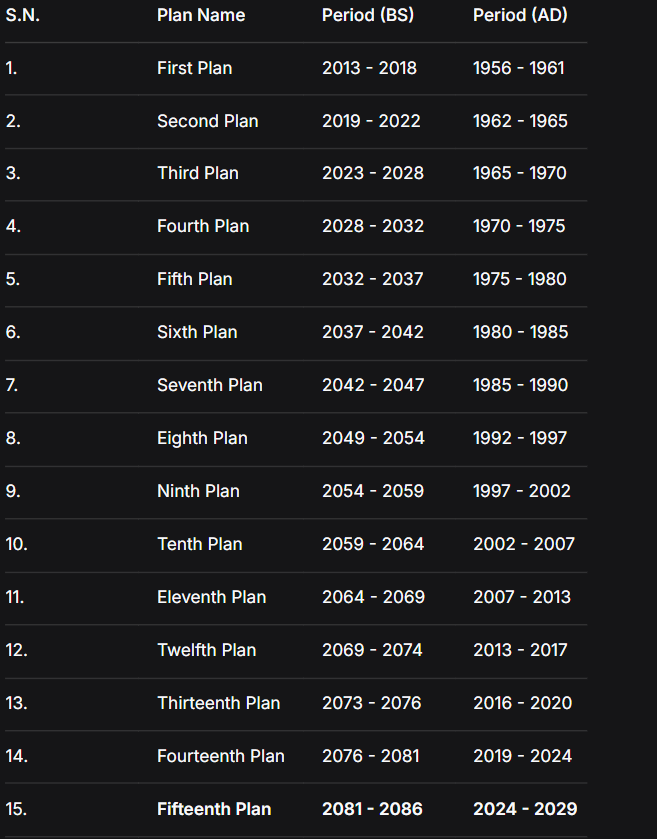
- Formal and systematic economic planning began only in 1956 AD (2013 BS) with the First Five-Year Plan.
- From then until now, Nepal has implemented Fifteen periodic plans.
- The period between plans (e.g., 1962-1965, 1979-1980) is called "Plan Holiday."
- After the constitution of 2015 AD (2072 BS), Nepal adopted a Federal System. Now, planning occurs at three levels:
- National Level (Central Government)
- Provincial Level (7 Provinces)
- Local Level (753 Local Governments)
- Table: History of Economic Plans in Nepal
3. Importance of Economic Planning
For a developing country like Nepal, economic planning is crucial because:
- To Reduce Poverty: It aims to uplift the poor by including programs for employment, education, health, and basic needs.
- To Reduce Unemployment: It creates jobs through skill development training, promoting self-employment, and labor-intensive projects.
- To Develop Infrastructure: It focuses on building the foundation for development—roads, bridges, electricity, irrigation, schools, and hospitals.
- To Develop Industries: It promotes industrial growth (like agriculture-based, cottage, small industries) by providing necessary policies, programs, and investment.
- To Increase Economic Growth Rate: It aims to achieve a high and sustainable rate of growth in national income and production.
4. Components of an Economic Plan
Every economic plan has the following key parts:
- Objectives: The broad, long-term aims (e.g., poverty reduction, high economic growth).
- Goals/Targets: The specific, measurable targets to achieve the objectives (e.g., increase GDP growth to 7%, reduce poverty to 15%).
- Policies: The set of rules and guidelines to achieve the goals (e.g., industrial policy, education policy).
- Priorities: The most important sectors that get resources first (e.g., agriculture, energy, infrastructure).
- Programs: The detailed action plans and projects to be implemented (e.g., "Build a specific highway," "Start a literacy campaign").
- Resource Mobilization & Allocation: Identifying sources of funds (tax, foreign aid, internal borrowing) and distributing them to different sectors.
- Monitoring and Evaluation: The process of regularly checking progress and assessing the final results of the plan.
5. Process of Economic Plan Formulation (in Nepal)
The National Planning Commission (NPC) is responsible for formulating the national plan. The process involves:
Step 1: Evaluation of Past Plans & Estimation for New Plan – Analyzing successes and failures of the previous plan.
Step 2: Collection and Presentation of New Plan Proposals – Gathering project ideas from all government levels and sectors.
Step 3: Discussion – Holding extensive consultations with experts, stakeholders, and the public.
Step 4: Determination of Objectives, Goals, Policies & Priorities – Finalizing the core elements of the plan.
Step 5: Legitimization and Execution – Getting approval from the government (Cabinet/Parliament) and implementing it through various agencies.
6. Features of Nepal's Current Plan (The Fifteenth Plan, 2024-2029)
This is Nepal's first plan under the fully implemented federal system.
- Vision: "Prosperous Nepal, Happy Nepali."
- Goal: To graduate from a Least Developed Country (LDC) status by 2026 and lay the foundation to become a developing country with a medium level of income by 2030.
- Objective: To achieve high economic growth through productive employment and entrepreneurship, reduce poverty, and bring about economic and social transformation.
- Key Quantitative Targets:
- Average annual economic growth rate: 8.2%
- Poverty rate to decrease to: 16.7%
- Agriculture sector growth: 4.8%
- Increase per capita electricity consumption to: 622 units
- Increase average life expectancy to: 72 years
Major Strategies:
- Transform agriculture, promote tourism and hydroelectricity.
- Develop infrastructure (transport, communication, urban development).
- Achieve rapid and inclusive social development (health, education).
- Ensure good governance, social justice, and inclusion.
- Enhance production, productivity, and institutional capacity.