1.0 Meaning and Definition of International Trade
Meaning:
International trade refers to the exchange of goods and services between countries. When Nepal imports petroleum from Saudi Arabia or exports carpets to the USA, that's international trade.
Examples from daily life:
Mobile phones (made in China, used in Nepal)
Rice (exported from Nepal to Bangladesh)
Doctors going abroad for work (service export)
Students studying in foreign countries (service import)
Definition:
According to D.G. Locket:
"International trade is the purchase of goods and services by the citizens of one country from the citizens of another country."
Simple Definition:
"International trade is the exchange of goods and services across international borders."
Why Countries Trade:
- No country is self-sufficient: Nepal can't produce everything it needs
- Different resources: Nepal has water resources, Saudi Arabia has oil
- Climate differences: Nepal grows tea, Gulf countries don't
- Different technology: Japan has advanced technology, Nepal doesn't
- Cost differences: Some goods cheaper to produce in certain countries
2.0 Importance of International Trade
Major Benefits:
Specialization and Division of Labor:
- Countries produce what they're best at
- Example: Nepal specializes in carpets, Bangladesh in garments
- Increases efficiency and productivity
Optimum Use of Resources:
- Countries use their resources best
- Nepal: Water for hydropower
- Middle East: Oil for energy
- Australia: Minerals for export
Availability of Various Goods:
- Consumers get variety
- Nepali people use iPhones, cars, computers from abroad
- Foreigners get Nepali tea, carpets, pashmina
Transfer of Technology:
- Advanced technology spreads
- Nepal gets medical equipment, machinery
- Learning new production methods
Increase in Employment:
- Export industries create jobs
- In Nepal: Carpet industry employs thousands
- Import industries also create jobs (distribution, sales)
Price Stability:
- Shortages can be imported
- Surplus can be exported
- Prevents price fluctuations
Economic Growth:
- Increases GDP
- More foreign exchange earnings
- Investment opportunities
International Cooperation:
- Countries become interdependent
- Promotes peace and understanding
- Cultural exchange
For Nepal Specifically:
- Earns foreign exchange: Exports bring US dollars
- Imports essential goods: Petroleum, medicines, machinery
- Employment: 2.5 million Nepalis work abroad
- Remittances: 25% of GDP from workers abroad
- Technology transfer: Get access to modern technology
3.0 Balance of Trade (BOT)
Definition:
Balance of Trade is the difference between a country's exports and imports of visible goods over a specific period (usually one year).
Formula:

Types of Balance of Trade:
- Favorable Balance of Trade (Trade Surplus):
- Exports > Imports
- Country earns more than spends
- Example: China usually has trade surplus
- For Nepal: Rare, only occasionally
2 .Unfavorable Balance of Trade (Trade Deficit):
- Imports > Exports
- Country spends more than earns
- Example: Nepal usually has trade deficit
Nepal's situation (2022):
- Exports: $1.2 billion
- Imports: $15.6 billion
- Trade Deficit: $14.4 billion
Balanced Balance of Trade:
- Exports = Imports
- Very rare in practice
- Temporary situation
Nepal's Trade Balance Situation:
- Chronic trade deficit since 1960s
- Main reasons:
- Limited industrial base
- High dependency on imports
- Low-value exports
- Landlocked country (high transport cost)
3. Major exports: Carpets, garments, pulses, tea
4. Major imports: Petroleum, machinery, vehicles, gold
4.0 Balance of Payments (BOP)
Definition:
Balance of Payments is a complete record of all economic transactions between a country and the rest of the world during a specific period.
Difference between BOT and BOP:
| Aspect | Balance of Trade | Balance of Payments |
|---|---|---|
| Scope | Only visible goods | Goods + Services + Capital transfers |
| Components | Exports & imports of goods | Current account + Capital account |
| Coverage | Narrow | Comprehensive |
| Measurement | Part of BOP | Complete picture |
Components of Balance of Payments:
A. Current Account:
- Trade Balance (Goods: exports-imports)
- Services (Tourism, transport, insurance)
- Income (Remittances, interest, dividends)
- Transfers (Grants, gifts, aid)
B. Capital Account:
- Foreign Direct Investment (FDI)
- Portfolio Investment
- Loans and borrowings
- Banking capital
C. Official Reserves Account:
- Changes in foreign exchange reserves
- Gold reserves
- SDRs with IMF
Formula:

Note: BOP always balances (theoretically)
Nepal's BOP Situation:
- Current Account: Usually deficit (due to trade deficit)
- Capital Account: Usually surplus (due to remittances, aid)
- Overall: Managed through reserves
- Foreign reserves: About $10 billion (2022)
5.0 Free Trade Policy
Meaning:
Free trade policy means no restrictions on international trade. Government doesn't impose tariffs, quotas, or other barriers.
Key features:
- No import/export duties
- No quotas or restrictions
- Market forces determine trade
- Example: Trade between US states
Advantages of Free Trade:
Efficiency:
- Countries specialize
- Resources used optimally
- Lower production costs
Consumer Benefits:
- More choices
- Lower prices
- Better quality
Economic Growth:
- Larger markets
- Economies of scale
- Innovation encouraged
International Relations:
- Promotes peace
- Cultural exchange
- Mutual dependence
Technology Transfer:
- Access to new technology
- Knowledge sharing
- Skills development
Disadvantages of Free Trade:
Harm to Domestic Industries:
- Local industries can't compete
- May shut down
- Job losses
Dependency:
- Over-reliance on imports
- Food security risk
- Strategic goods dependency
Exploitation:
- Developed countries dominate
- Unequal bargaining power
- Price manipulation
Environmental Issues:
- Pollution from transportation
- Resource depletion
- Carbon footprint
Cultural Impact:
- Loss of local culture
- Westernization
- Traditional skills lost
Relevance to Nepal:
- Nepal follows mixed policy
- Some free trade (with India, under SAFTA)
- Some protection (to safeguard local industries)
- WTO membership requires reducing trade barriers
6.0 Protection Trade Policy
Meaning:
Protection policy means government imposes restrictions on international trade to protect domestic industries.
Protection measures:
Tariffs: Taxes on imports
Quotas: Limits on quantity
Subsidies: Support to local producers
Exchange control: Restrictions on foreign currency
Quality standards: Strict requirements
Objectives of Protection Policy:
Protect Infant Industries:
- New industries need time
- Can't compete with established foreign industries
- Example: Nepal's cement industry needed protection
Employment Protection:
- Save local jobs
- Prevent factory closures
- Maintain living standards
National Security:
- Essential goods produced domestically
- Food security
- Strategic industries (defense, energy)
Balance of Payments:
- Reduce imports
- Improve trade balance
- Save foreign exchange
Revenue Generation:
- Tariffs provide government revenue
- Important for developing countries
Methods of Protection:
Tariff Barriers:
- Import duties
- Export duties
- Transit duties
Non-Tariff Barriers:
- Import quotas
- Licensing
- Technical standards
- Health regulations
- Environmental standards
Advantages for Nepal:
- Protects local industries: Cement, sugar, textiles
- Saves foreign exchange: Reduces unnecessary imports
- Employment: Protects jobs in local industries
- Self-reliance: Reduces dependency
- Government revenue: From tariffs
Disadvantages for Nepal:
- Higher prices: Consumers pay more
- Inefficiency: Protected industries become lazy
- Limited choices: Fewer goods available
- Retaliation: Other countries impose barriers
- Corruption: Licensing can lead to corruption
7.0 Comparative Cost Theory
Developer: David Ricardo (1817)
Basic Concept:
Countries should specialize in producing goods where they have comparative advantage
Even if one country is better at producing everything, both can benefit from trade
Key Assumptions:
- Two countries, two goods
- Labor is only factor of production
- Constant returns to scale
- No transportation costs
- Perfect competition
- Free trade
- Full employment
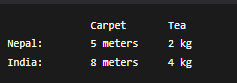
Example: Nepal vs. India
Production capacity (per worker per day):
Absolute Advantage:
India is better at producing both (absolute advantage in both)
Comparative Advantage:
- Calculate opportunity cost:
- Nepal: 1 meter carpet = 0.4 kg tea (2/5)
- India: 1 meter carpet = 0.5 kg tea (4/8)
- Nepal has lower opportunity cost for carpets (comparative advantage)
- India has lower opportunity cost for tea (comparative advantage)
Specialization:
- Nepal specializes in carpets
- India specializes in tea
- Both trade and both benefit
Gains from Trade:
- Increased total production: More of both goods
- Lower prices: Due to specialization
- Better resource allocation: Each country uses resources efficiently
- Higher consumption: Both countries can consume more
Criticisms:
- Unrealistic assumptions: No transport costs, perfect competition
- Only two countries, two goods: Real world more complex
- Ignores other factors: Capital, technology, land
- Static theory: Doesn't consider changes over time
- Assumes full employment: Not realistic
Relevance to Nepal:
- Nepal has comparative advantage in:
- Hydropower
- Tourism
- Agriculture (organic)
- Handicrafts
- Should specialize in these areas
8.0 World Trade Organization (WTO)
Background:
- Established: 1 January 1995
- Headquarters: Geneva, Switzerland
- Replaced: GATT (General Agreement on Tariffs and Trade)
- Members: 164 countries (2022)
- Nepal joined: 23 April 2004
Objectives:
- Promote free trade: Reduce trade barriers
- Ensure non-discrimination: Most Favored Nation (MFN) principle
- Provide forum for negotiations: Settle trade disputes
- Assist developing countries: Technical assistance
- Sustainable development: Balance trade and environment
Principles:
- Most-Favored-Nation (MFN): Equal treatment to all members
- National Treatment: Foreign and local goods treated equally
- Transparency: Clear trade rules and regulations
- Free Trade: Progressive liberalization
- Fair Competition: Anti-dumping measures
Functions:
- Administer trade agreements
- Forum for trade negotiations
- Handle trade disputes
- Monitor trade policies
- Technical assistance to developing countries
- Cooperation with other international organizations
Benefits for Nepal:
- Market access: 163 other countries
- Dispute settlement mechanism: Fair treatment
- Technical assistance: Capacity building
- Policy guidance: Trade policy formulation
- Participation in global trade system
Challenges for Nepal:
- Implementation costs: Expensive to implement agreements
- Competition: Local industries face global competition
- Intellectual property rights: TRIPS agreement challenges
- Agriculture subsidies: Developed countries subsidize their farmers
- Capacity constraints: Lack of expertise
9.0 South Asian Free Trade Area (SAFTA)
Background:
- Established: 6 January 2004 (came into force 1 January 2006)
- Members: 8 SAARC countries
- Afghanistan, Bangladesh, Bhutan, India, Maldives, Nepal, Pakistan, Sri Lanka
- Objective: Create free trade area in South Asia
Key Features:
- Tariff reduction: Gradual reduction to 0-5%
- Sensitive lists: Some products protected
- Rules of origin: Criteria for preferential treatment
- Dispute settlement mechanism
- Technical assistance
Objectives:
- Promote trade: Among SAARC countries
- Economic cooperation: Joint projects
- Remove trade barriers: Tariffs and non-tariff barriers
- Increase investment: Regional investment
- Poverty reduction: Through economic growth
Benefits for Nepal:
- Market access: To 7 neighboring countries
- Geographical advantage: Close to large markets
- Similar products: Preferences for similar climates
- Cultural similarity: Similar consumer preferences
- Transport cost: Lower than distant markets
Challenges for Nepal:
- Trade deficit: With all SAARC countries, especially India
- Non-tariff barriers: Still exist
- Infrastructure: Poor transport connectivity
- Product competitiveness: Can't compete with India, Bangladesh
- Sensitive lists: Many Nepali products on India's sensitive list
Nepal's Trade with SAARC (2022):
- Total trade: $8.5 billion
- With India: $8.2 billion (96%)
- Exports to SAARC: $0.9 billion
- Imports from SAARC: $7.6 billion
- Trade deficit: $6.7 billion
10.0 Nepal's Foreign Trade: Current Status
Trade Statistics (2022/23):
- Total trade: $16.8 billion
- Exports: $1.2 billion (7.1%)
- Imports: $15.6 billion (92.9%)
- Trade deficit: $14.4 billion
Major Export Items:
- Carpets: $87 million
- Yarn: $75 million
- Cardamom: $65 million
- Noodles: $62 million
- Tea: $33 million
- Pashmina: $28 million
- Readymade garments: $25 million
Major Import Items:
- Petroleum products: $2.5 billion
- Machinery/parts: $1.8 billion
- Vehicles: $1.2 billion
- Iron and steel: $1.1 billion
- Gold: $0.9 billion
- Medicines: $0.5 billion
- Cement: $0.4 billion
Major Trading Partners:
India: 64% of total trade
China: 14%
USA: 6%
UAE: 4%
Other countries: 12%
Problems in Nepal's Foreign Trade:
- Chronic trade deficit: Import > Export for decades
- Limited export basket: Few products, low value
- Concentration on few markets: Over 60% with India
- High import dependency: Essential goods imported
- Low productivity: Traditional methods, small scale
- Infrastructure constraints: Poor transport, storage
- Non-tariff barriers: From trading partners
- Quality issues: Don't meet international standards
- Political instability: Affects trade policy
- Landlocked: High transport costs
Government Initiatives:
Trade Policy 2015: Export promotion, import substitution
- Special Economic Zones: Birgunj, Bhairahawa, Simara
- Export incentives: Cash incentives for exporters
- Trade agreements: With India, China, others
- Quality certification: Help for exporters
- Trade fairs: Participation in international fairs
- Export houses: Support for export businesses
11.0 Recent Developments in Nepal's Trade
Key Agreements:
Nepal-India Trade Treaty (2009, renewed):
- Preferential access to Indian market
- Some tariff concessions
- Transit rights through India
- Nepal-China Transit Agreement (2016):
- Access to Chinese ports
- Alternative to Indian route
- Not fully utilized yet
- Nepal-Bangladesh Trade Agreement:
- Preferential treatment
- Transit through India
- Electricity export potential
Emerging Opportunities:
- Hydropower export: To India, Bangladesh
- IT services: Growing sector
- Medical tourism: Quality at lower cost
- Organic agriculture: For export markets
- Herbal products: Ayurvedic medicines
- Education services: For foreign students
Challenges:
- COVID-19 impact: Disrupted supply chains
- Global recession: Reduced demand
- Climate change: Affects agriculture exports
- Geopolitical tensions: India-China relations affect Nepal
- Internal issues: Political instability, corruption
Important Formulas and Calculations
1. Balance of Trade:

Example:
Exports: $1,200 million
Imports: $15,600 million
BOT = 1,200 - 15,600 = -$14,400 million (deficit)
2. Export-Import Ratio:

Example for Nepal:
Ratio = (1,200 ÷ 15,600) × 100% = 7.7%
3. Trade Dependence Ratio:

Example for Nepal:
Total trade: $16,800 million
GDP: $36,000 million
Dependence = (16,800 ÷ 36,000) × 100% = 46.7%
4. Comparative Advantage Calculation:
Step 1: Calculate production per unit
Step 2: Calculate opportunity cost
Step 3: Identify comparative advantage
Step 4: Determine specialization
Case Studies
Case 1: Nepal's Carpet Industry
History: Started 1960s
Success factors: Cheap labor, traditional skills
Challenges: Competition from China, India
Current status: Second largest export
Lesson: Traditional industries can be competitive
Case 2: Bangladesh's Garment Industry
Growth: From zero to $35 billion exports
Success factors: Cheap labor, MFA quotas, government support
Employment: 4 million workers
Lesson: Right policies can transform an industry
Case 3: India's IT Services
Growth: $150 billion exports
Success factors: English education, time zone, government support
Lesson: Services can be major export
Case 4: China's Manufacturing
"World's factory": $2.5 trillion exports
Success factors: Infrastructure, labor, government support
Lesson: Scale matters in manufacturing
Important Definitions (for Exam)
- International Trade: Exchange of goods and services between countries.
- Balance of Trade: Difference between exports and imports of goods.
- Balance of Payments: Complete record of all economic transactions with other countries.
- Free Trade: Trade without government restrictions.
- Protection Policy: Government restrictions to protect domestic industries.
- Comparative Advantage: Ability to produce at lower opportunity cost.
- WTO: World Trade Organization, global trade regulating body.
- SAFTA: South Asian Free Trade Area, regional trade agreement.
- Tariff: Tax on imports or exports.
- Quota: Limit on quantity of imports or exports.