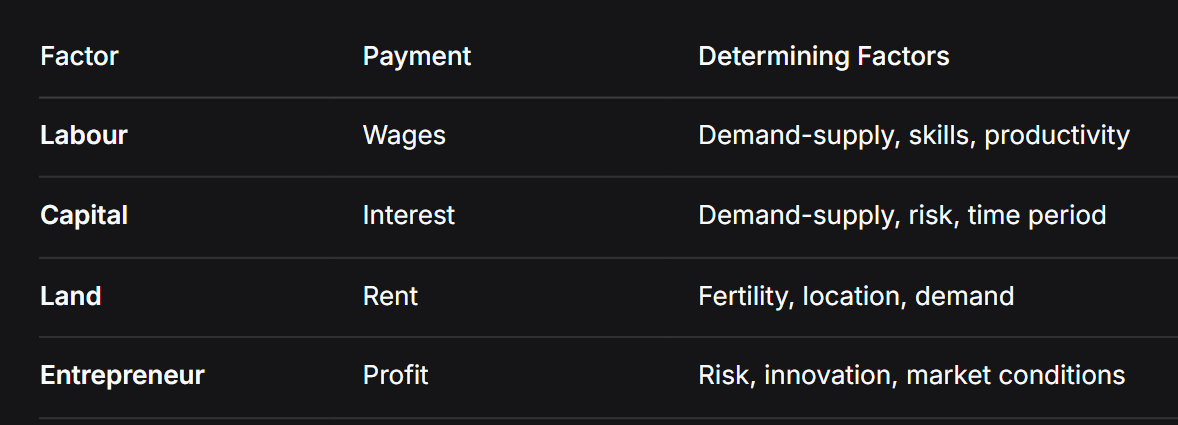
This chapter explains how factor payments (rent, wages, interest, profit) are determined in economics. We study different theories that explain why landowners get rent, workers receive wages, capitalists earn interest, and entrepreneurs obtain profit for their contributions to production.
Unit 1: Introduction to Factor Pricing
1.1 Definition
Factor Pricing refers to the determination of prices/remuneration for factors of production:
- Land → Rent
- Labour → Wages
- Capital → Interest
- Entrepreneurship → Profit
Unit 2: Wages
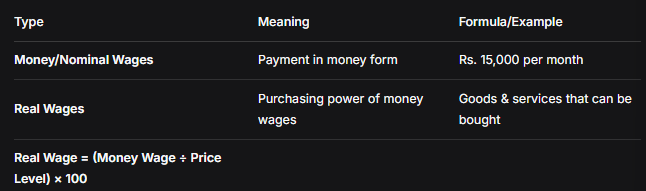
2.1 Definition of Wages
Wages are payments made to workers for their labour services.
Types of Wages:
2.2 Subsistence Theory of Wages (Iron Law of Wages)
- Propounded by: David Ricardo, Ferdinand Lassalle
- Main Idea: In long run, wages tend to settle at subsistence level (minimum needed for survival)
- Process:
→ If wages > subsistence → Population increases → Labour supply increases → Wages fall
→ If wages < subsistence → Population decreases → Labour supply decreases → Wages rise - Criticisms:
- Assumes population depends only on wages
- Ignores role of trade unions
- Doesn't consider differences in skills/abilities
Unit 3: Interest
3.1 Definition of Interest
Interest is payment for using capital or loanable funds.
Types of Interest:

3.2 Classical Theory of Interest
Propounded by: Alfred Marshall, A.C. Pigou
Main Idea: Interest determined by demand for capital (investment) and supply of capital (saving)
Equilibrium: Where Demand for Capital = Supply of Capital
Diagram:
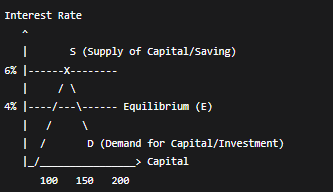
Equilibrium Interest Rate: 4%
Equilibrium Capital: 150 units
Unit 4: Profit
4.1 Definition of Profit
Profit is the reward for entrepreneurship and risk-taking.
Types of Profit:

4.2 Risk and Uncertainty Theory of Profit
- Propounded by: Frank H. Knight
- Main Idea: Profit is reward for bearing uninsurable risks (uncertainty)
- Two types of risks:
- Insurable risks (Fire, theft) → No profit
- Uninsurable risks (Market changes, new competition) → Source of profit
- Criticisms:
- Profit arises from other factors too (innovation, monopoly)
- Some risks can be insured
Unit 5: Rent
5.1 Definition of Rent
Rent is payment for using land or any factor whose supply is fixed.
Types of Rent:

5.2 Ricardian Theory of Rent
- Propounded by: David Ricardo
- Main Ideas:
- Rent arises due to difference in fertility of land
- No-rent land exists (marginal land)
- Rent = Produce of superior land - Produce of marginal land
- Rent is price-determined, not price-determining
Ricardo's Example:

Diagram:
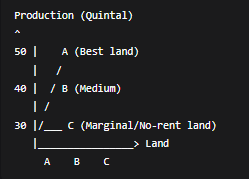
- C = Marginal land (no rent)
- Rent of A = 50-30 = 20 quintals
- Rent of B = 40-30 = 10 quintals
Criticisms of Ricardian Theory:
- Assumes original fertility (ignores improvements)
- Assumes perfect competition
- Neglects scarcity value of land
Key Concepts & Definitions
- Factor Pricing: Determining payments to factors of production
- Subsistence Wage: Minimum wage for survival
- Pure Interest: Payment for capital use only
- Economic Rent: Payment above opportunity cost
- Net Profit: Reward for risk and innovation
- Marginal Land: Land that yields no rent
- Transfer Earnings: Minimum payment to keep factor in current use
Important Formulas
- Real Wage = (Money Wage ÷ Price Index) × 100
- Gross Interest = Pure Interest + Risk premium + Management cost
- Economic Rent = Actual earnings - Transfer earnings
- Net Profit = Gross profit - Implicit costs
Comparison Table