Unit 1: Barter System
1.1 Definition of Barter System
Barter System is the direct exchange of goods and services without using money.
Example: A farmer exchanges rice for clothes with a weaver.
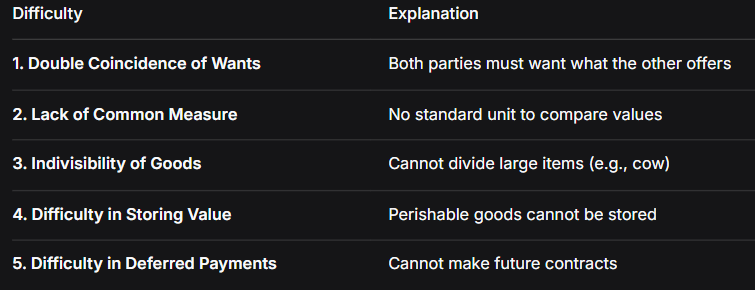
1.2 Difficulties of Barter System
Unit 2: Money
2.1 Definition of Money
Money is anything generally accepted as:
- Medium of exchange
- Measure of value
- Store of value
- Standard for deferred payments
According to Prof. Crowther:
"Money is anything that is generally acceptable as a means of exchange and acts as a measure and store of value."
2.2 Evolution of Money
- Commodity Money → Goods used as money (salt, cattle, grains)
- Metallic Money → Gold, silver, copper coins
- Paper Money → Currency notes issued by central bank
- Bank Money → Cheques, credit cards, digital money
- Plastic Money → Debit cards, credit cards
- Digital Money → Mobile banking, e-wallets
2.3 Types of Money
A. Based on Authority:

B. Based on Material:

2.4 Functions of Money
Primary Functions:
- Medium of Exchange → Facilitates buying-selling
- Measure of Value → Measures worth of goods
Secondary Functions:
- Store of Value → Can save for future
- Standard of Deferred Payments → Future contracts possible
- Transfer of Value → Transfer wealth between places
Contingent Functions:
- Basis of Credit → Basis for loans
- Distribution of National Income → Divides income among factors
- Liquidity → Can convert to goods anytime
Unit 3: Banking System
3.1 Definition of Bank
Bank is a financial institution that:
- Accepts deposits from public
- Lends money to borrowers
- Provides other financial services
According to C.R. Crowther:
"A banker is a dealer in debts – his own and of other people."
3.2 Classification of Banks in Nepal
A. Central Bank:
- Name: Nepal Rastra Bank (NRB)
- Established: 2016 BS (1956 AD)
- Functions:
- Issues currency
- Banker to government
- Banker to other banks
- Controls credit
- Manages foreign exchange
B. Commercial Banks:
- Number: 28 (as of 2078 BS)
- Examples: Nepal Bank Ltd., Rastriya Banijya Bank, Nabil Bank, etc.
- Functions:
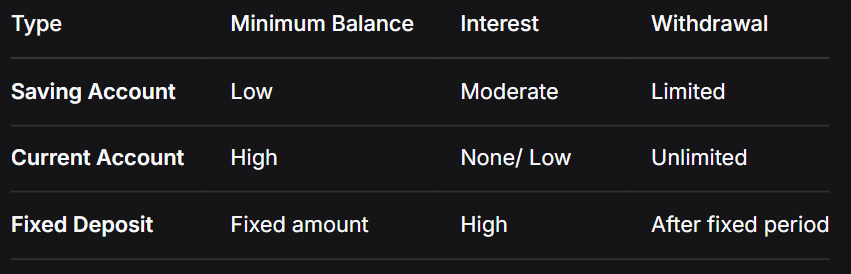
- Accept deposits (saving, current, fixed)
- Provide loans
- Remittance services
- Issue cheques
- Safe deposit lockers
C. Development Banks:
- Number: 36
- Examples: Agricultural Development Bank, Nepal Industrial Development Corp.
- Purpose: Provide long-term loans for development projects
D. Finance Companies:
- Number: 25
- Function: Provide credit facilities
E. Microfinance Institutions:
Number: 64
Purpose: Provide small loans to poor people
3.3 Types of Bank Accounts
Unit 4: Credit Instruments
4.1 Definition
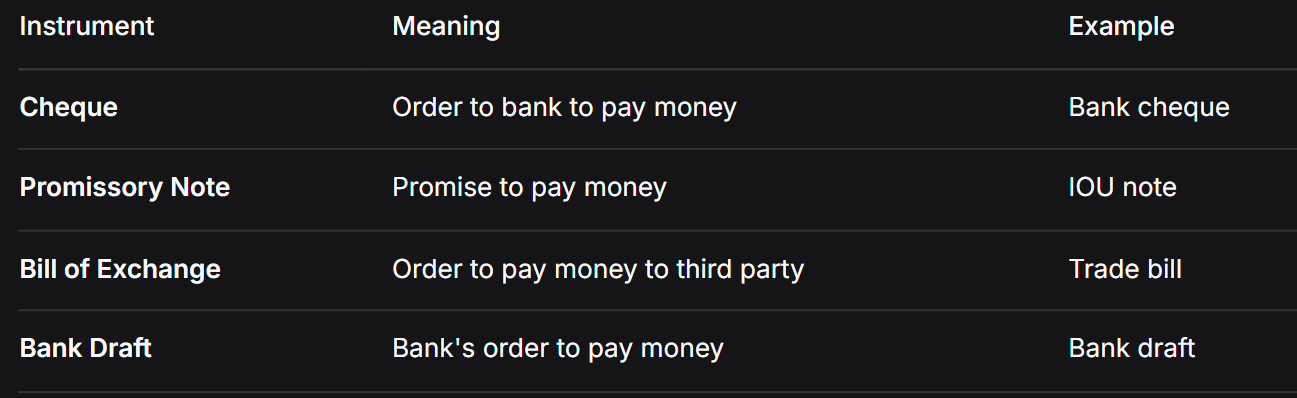
Credit Instruments are documents that create credit/money.
4.2 Types of Credit Instruments
4.3 Importance of Credit Instruments
- Reduces use of cash
- Safe and convenient
- Promotes banking habits
- Facilitates trade
- Basis for economic development
Unit 5: Money Market vs Capital Market
5.1 Money Market
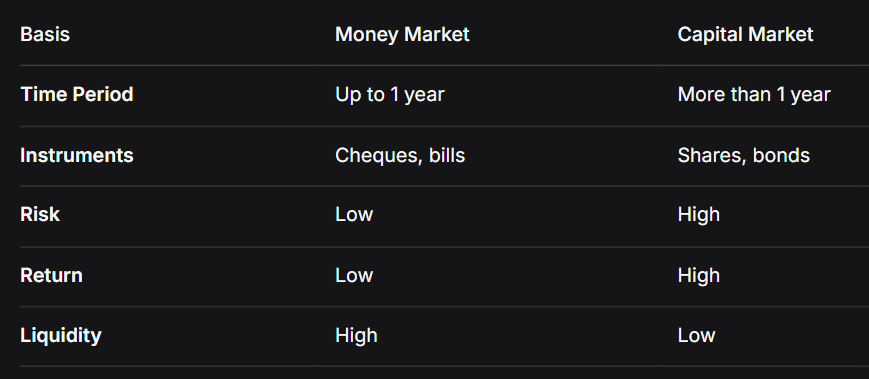
- Period: Short-term (up to 1 year)
- Instruments: Treasury bills, commercial papers, call money
- Purpose: Meet short-term financial needs
- Participants: Commercial banks, finance companies
5.2 Capital Market
- Period: Long-term (more than 1 year)
- Instruments: Shares, bonds, debentures
- Purpose: Meet long-term investment needs
- Participants: Development banks, stock market
5.3 Differences:
Unit 6: Non-Banking Financial Institutions (NBFIs)
6.1 Definition
NBFIs are financial institutions that don't have full banking license but provide financial services.
6.2 Types of NBFIs in Nepal
A. Insurance Companies:
- Life Insurance: Covers human life risk
- Non-Life Insurance: Covers property, vehicles, health
Major Insurance Companies in Nepal:
- Nepal Insurance Company Ltd.
- National Life Insurance Company
- MetLife Nepal
- Prime Life Insurance
- Asian Life Insurance
B. Finance Companies:
Provide loans for various purposes
C. Cooperatives:
Provide financial services to members
6.3 Importance of NBFIs
- Provide specialized services
- Promote savings
- Provide credit facilities
- Risk management through insurance
- Financial inclusion
Key Terms & Definitions
- Barter System: Direct exchange of goods without money
- Money: Generally accepted medium of exchange
- Bank: Financial institution accepting deposits and lending money
- Cheque: Written order to bank to pay money
- Credit: Trust allowing deferred payment
- Insurance: Protection against financial loss
- Interest: Payment for using borrowed money
- Deposit: Money placed in bank account
- Loan: Money borrowed from bank
- Digital Banking: Banking through electronic means
Important Points about Nepal
- Central Bank: Nepal Rastra Bank (established 2016 BS)
- First Commercial Bank: Nepal Bank Ltd. (established 1994 BS)
- Currency: Nepalese Rupee (Rs.)
- Currency Notes: Rs. 5, 10, 20, 50, 100, 500, 1000
- Insurance Regulator: Insurance Board of Nepal
- Stock Exchange: Nepal Stock Exchange (NEPSE)