POPULATION, ENVIRONMENT AND DEVELOPMENT
🔹 DEFINITION OF KEY TERMS:
- Population: The total number of people living in a specific area at a given time.
- Environment: The surroundings or conditions in which a person, animal, or plant lives, including natural (air, water, land) and human-made elements.
- Development: The process of improving people's quality of life through economic, social, and technological advancement.
🔹 INTERRELATIONSHIP CONCEPT:
Population, Environment and Development are like three legs of a stool - if one is weak, the whole system collapses.
🔹 MAJOR INTERRELATED ACTIVITIES:
1. AGRICULTURE
- Definition: The science, art, or practice of cultivating the soil, producing crops, and raising livestock.
- Nepal's Status: Agricultural country (1/3 of GDP)
- Problems: Traditional methods, unscientific farming, poor land policies
- Solutions: Scientific land distribution, farmer training, eco-friendly practices
2. INDUSTRY
- Definition: Economic activity concerned with the processing of raw materials and manufacture of goods in factories.
- Role: Provides employment, improves quality of life
- Environmental Impact: Uses raw materials, causes pollution
- Relation to Population: Attracts people → population growth
3. HEALTH
- Definition: State of complete physical, mental, and social well-being (WHO).
- Government Responsibility: Basic right of citizens
- Components: Hospitals, health posts, clean water, sanitation
- Environmental Needs: Fresh air, safe water, hygiene
4. SOCIAL SECURITY
- Definition: Government programs that provide financial assistance to people with inadequate or no income.
- Purpose: Equity, dignity for marginalized groups
- Benefits: Reduces poverty, protects environment from overuse
- Target Groups: Women, elderly, indigenous people
5. HOUSING/TOWN PLANNING
- Definition: Planned development of residential areas with proper facilities.
- Urban Planning: Town planning with waste management
- Effects: Reduces pollution, affects population distribution
- Importance: Quality shelter = quality life
6. EDUCATION
- Definition: Process of receiving or giving systematic instruction.
- Role: Produces skilled human resources
- Development Aspect: Schools, colleges, training centers
- Environmental Link: Educated people = better conservation
7. COMMUNICATION
- Definition: Process of exchanging information between individuals.
- Modern Age: Information Technology (IT) era
- Tools: Radio, TV, newspaper, internet, mobile
- Benefits: Global village concept, helps development planning
8. HUMAN RESOURCES
- Definition: People who work in an organization or are available for work.
- Types: Skilled, semi-skilled, unskilled
- Nepal's Challenge: Brain drain (skilled people leaving)
- Solution: Create local employment opportunities
9. EMPLOYMENT
- Definition: Condition of having paid work.
- Importance: Financial independence, national development
- Nepal's Issue: Foreign employment trend
- Opportunities: Use natural resources (water, forests, land)
10. CULTURE
- Definition: Customs, arts, social institutions of a particular group.
- Components: Language, religion, food, clothing, traditions
- Economic Value: Tourism attraction → income
- Conservation: Cultural heritage = environmental heritage
3.1.1 POPULATION PROGRAMS OF NEPAL
🔹 HISTORICAL TIMELINE:
| Plan Period | Focus Area | Key Achievement |
|---|---|---|
| First Plan | Population distribution | Basic attention |
| Third Plan | Population growth control | Shift to fertility reduction |
| Sixth Plan (1983) | Comprehensive strategy | National Population Strategy |
| Seventh Plan | Implementation | Adoption of previous strategies |
🔹 NATIONAL POPULATION STRATEGY 1983:
- Milestone in population policy
- Set quantitative targets for fertility reduction
- Emphasized integration with development activities
- Limitation: Poor implementation
3.2 REGIONAL BALANCE IN DEVELOPMENT
🔹 DEFINITIONS:
- Regional Balance: Equal development opportunities across all geographical regions.
- Regional Disparity: Unequal development between different areas.
🔹 CAUSES OF IMBALANCE IN NEPAL:
- Geographical Factors: Mountains/hills difficult for development
- Policy Bias: Development favored accessible areas
- Resource Distribution: Natural resources unevenly spread
- Infrastructure: Poor roads in remote areas
🔹 GOVERNMENT EFFORTS:
- Started in: Fourth Plan (1970-1975)
- Recent Change: Federal system (7 provinces, 2015 constitution)
- Goal: Decentralize power for balanced development
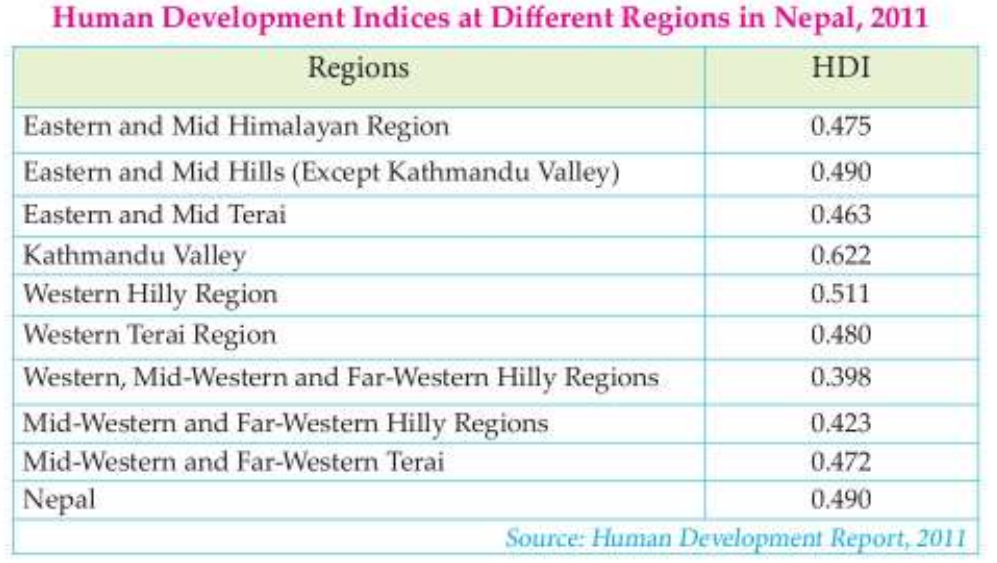
🔹 HUMAN DEVELOPMENT INDEX (HDI) 2011:
- HDI Definition: A statistic composite index of life expectancy, education, and per capita income.
Regional Comparison: - Highest: Kathmandu Valley (0.622)
- Lowest: Far-Western Hills (0.398)
- National Average: 0.490
Conclusion: Clear evidence of regional imbalance
🔹 REQUIREMENTS FOR BALANCED DEVELOPMENT:
- Land Use Planning: Scientific use of regional resources
- Infrastructure: Roads connecting all regions
- Investment: Both local and foreign in all areas
- Federalism: Local governments addressing local needs
3.2.1 NEED FOR BALANCED REGIONAL DEVELOPMENT
8 MAJOR REASONS:
- Economic Growth: All regions contribute to national economy
- Resource Optimization: Each region uses its unique resources
- Political Stability: Reduces regional tensions and conflicts
- Social Equality: Eliminates discrimination and injustice
- Employment Generation: Jobs created everywhere
- Urban-Rural Balance: Prevents overcrowding in cities
- National Unity: All citizens feel included and valued
- Sustainable Future: Long-term development for all
3.3 SUSTAINABLE DEVELOPMENT
🔹 3.3.1 CONCEPT AND DEFINITION
Sustainable Development Definition:
“Development that meets the needs of the present without compromising the ability of future generations to meet their own needs.”- Brundtland Commission, 1987
Key Terms:
- Sustainable: Able to be maintained at a certain rate or level
- Carrying Capacity: Maximum population size an environment can sustain
- Brundtland Commission:
- Formed: 1983 by United Nations
- Chairperson: Gro Harlem Brundtland (Norway's Prime Minister)
- Report: "Our Common Future" (1987)
🔹 3.3.2 PRINCIPLES OF SUSTAINABLE DEVELOPMENT
8 CORE PRINCIPLES:
- Society Sustainability: Meet basic needs (health, education, water)
- Ecosystem Conservation: Protect natural systems
- Biodiversity Protection: Preserve all species
- Population Control: Manage population growth
- Human Resource Development: Train skilled people
- Public Participation: Involve local communities
- Cultural Heritage Conservation: Respect traditional knowledge
- Respect Carrying Capacity: Don't exceed nature's limits
🔹 3.3.3 IMPORTANCE OF SUSTAINABLE DEVELOPMENT
7 KEY IMPORTANCES:
- Resource Management: Wise use without overexploitation
- Accountability: People responsible for environmental damage
- Basic Needs Focus: Priority to food, health, education
- Community Involvement: Local people participate and benefit
- Limits Recognition: Development within nature's capacity
- Future Planning: Considers next generations' needs
- Ecosystem Protection: Maintains balance in nature
🔹 3.3.4 APPLICATION IN REAL LIFE
5 PRACTICAL WAYS TO APPLY:
- Minimize Resource Use: Take only what you need
- Plan Urbanization: Cities designed with green spaces
- Study Impacts First: Check environmental effects before projects
- Promote Organic Farming: Chemical-free agriculture
- Control Population: Family planning and education
📚 CHAPTER SUMMARY IN ONE PAGE
THE BIG PICTURE:
- Three Interconnected Elements:
- Population: Consumers and workers
- Environment: Resource provider
- Development: Quality of life improvement
NEPAL'S CHALLENGES:
✅ Regional Imbalance: Hills vs Terai development gap
✅ Resource Management: Overuse vs conservation
✅ Population Pressure: Growing needs vs limited resources
SOLUTIONS:
- Balanced Development: Federal system, equal opportunities
- Sustainable Practices: Think long-term, conserve for future
- Integrated Approach: All activities consider population + environment
KEY DATES TO REMEMBER:
- 1983: Brundtland Commission formed
- 1987: "Our Common Future" report
- 1970-1975: Fourth Plan (balanced development focus)
- 2015: Federal system implemented
🎯 EXAM PREPARATION TIPS
MEMORIZATION TECHNIQUES:
Acronym for Activities: A I H S H E C H E C
(Agriculture, Industry, Health, Social security, Housing, Education, Communication, Human resource, Employment, Culture)
8 Needs of Balanced Development: E-R-P-S-E-N-U-S
- Economic growth
- Resource optimization
- Political stability
- Social equality
- Employment
- National unity
- Urban-rural balance
- Sustainable future
Principles of Sustainable Development: S-E-B-P-H-P-C-C
- Society
- Ecosystem
- Biodiversity
- Population control
- Human resource
- Public participation
- Cultural heritage
- Carrying capacity
DIAGRAMS TO PRACTICE:
- Interrelationship diagram of Population-Environment-Development
- Sustainable Development Venn diagram (Social-Economic-Environmental)
- Nepal's geographical regions with HDI values
- Timeline of Nepal's population programs