2.1 Demographic Components, Process and Measurement
Introduction to Demography
- Demography: Scientific study of human population (size, composition, distribution, change)
- Derived from Greek: "Demos" = people, "Graphia" = writing/study
- Father of Demography: John Graunt (1662)
- First to use term "Demography": Achille Guillard (1855)
Three Demographic Components
Birth → Increases population
Death → Decreases population
Migration → Movement of people
- In-migration increases population
- Out-migration decreases population
Demographic Process & Measurement
| Component | Process | Measurement Examples |
|---|---|---|
| Birth | Fertility | CBR, GFR, ASFR, TFR |
| Death | Mortality | CDR, ASDR, IMR, MMR |
| Migration | Migration | In-migration rate, Out-migration rate, NMR, GMR |
2.2 Fertility Measures
1. Crude Birth Rate (CBR)
Simplest measure
Formula:

Mid-year population: Population on July 1
Nepal (2068 BS): CBR = 21.8 per 1000
2. General Fertility Rate (GFR)
More refined than CBR
Formula:

Nepal (2068 BS): GFR = 96 per 1000
3. Age-Specific Fertility Rate (ASFR)
Most detailed fertility measure
Formula:

Example: Nepal's highest ASFR in 20-24 age group
4. Total Fertility Rate (TFR)
Average number of children a woman bears in her lifetime
Formula:
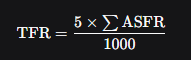
Replacement level: 2.1 children per woman
Nepal's TTR:
- 2068 BS: 2.6
- Urban: 1.6
- Rural: 2.8
Important Terms
Fertility: Actual childbearing performance
Fecundity: Biological capacity to bear children (15-49 years for women)
Reproductive age: 15-49 years for women
2.3 Mortality Measures
1. Crude Death Rate (CDR)
Formula:

Nepal (2068 BS): CDR = 7.3 per 1000
2. Age-Specific Death Rate (ASDR)
Formula:

3. Infant Mortality Rate (IMR)
Deaths of children under 1 year
Formula:

Important indicator of health and socioeconomic development
4. Maternal Mortality Ratio (MMR)
Death of woman during pregnancy or within 42 days after termination
Formula:

2.4 Migration Measures
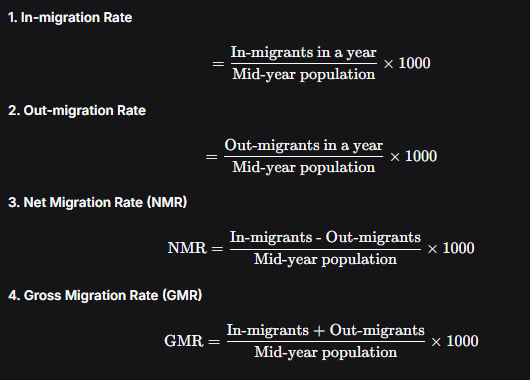
2.5 Population Growth Indicators
1. Natural Increase Rate (NIR)
\text{NIR} = \frac{\text{CBR - CDR}}{10} \ (\text{in %})
-Example: Nepal 2068: CBR=21.8, CDR=7.3 → NIR = 1.45%
2. Population Growth Rate (PGR)
\text{PGR} = \frac{(\text{CBR - CDR}) \pm \text{NMR}}{10} \ (\text{in %})
3. Doubling Time (PDT)

Rule of 70: If PGR=2%, PDT=35 years
4. Dependency Ratio (DR)

5. Sex Ratio

Nepal (2068): 94.16 (94 males per 100 females)
2.6 Consequences of Rapid Population Growth (RPG)
Environmental Impacts
- Deforestation & Biodiversity Loss
- Forest cover in Nepal decreased from 45% to 40.36%
- Loss of wildlife habitats
- Land Degradation & Soil Erosion
- Cultivation on slopes causes landslides
- Overgrazing reduces soil fertility
- Floods & Landslides
- Deforestation increases flood frequency
- Example: Annual floods in Terai
- Air Pollution
- Industrialization, vehicles, urbanization
- Respiratory diseases increase
- Water Pollution
- Industrial waste, sewage, agricultural chemicals
- Diseases: Cholera, Typhoid, Hepatitis
- Noise Pollution
- Urbanization, vehicles, industries
- Hearing loss, stress, sleep disturbance
- Depletion of Mineral Resources
- Over-extraction of minerals
- Non-renewable resources exhaustion
Socio-economic Impacts
- Health Problems
- Overcrowded health services
- High IMR and MMR
- Malnutrition
- Education Challenges
- Lack of schools and teachers
- Low quality education
- Nepal literacy (2068): 65.9%
- Unemployment
- More job seekers than opportunities
- Youth unemployment high
- Food Security Issues
- Food production can't match population growth
- Nepal: From food exporter to importer
- Housing Shortage
- Slums in urban areas
- Poor sanitation
- Clothing Shortage
- Increased demand raises prices
- Dependence on imports
- Security Issues
- Increased crime rates
- Reduced recreational spaces
- Cultural Heritage Loss
- Traditional culture threatened
- Historical sites damaged
2.7 Population Management
Direct Methods
- Delayed marriage (especially for girls)
- Birth spacing (3-5 years between children)
- Legal abortion (under medical supervision)
- Migration control (planned settlement)
- Family planning (various methods)
Indirect Methods
- Population education
- Awareness raising
- Women empowerment
- Gender equality
- Employment generation
- Poverty reduction
2.8 Family Planning Methods
A. Natural Methods
Withdrawal (Coitus interruptus)
- Man withdraws before ejaculation
- Effectiveness: 78%
Rhythm/Calendar Method
- Avoiding sex during fertile period
- For regular 28-day cycle: Avoid days 10-19
- Effectiveness: 76%
Cervical Mucus Method
- Checking vaginal mucus consistency
- Stretchy mucus = fertile
- Effectiveness: Variable
Lactational Amenorrhea (LAM)
- Exclusive breastfeeding for 6 months
- Effectiveness: 99% for first 6 months
B. Artificial/Temporary Methods
Condom (Male)
- Prevents sperm entry
- Effectiveness: 98%
- Also prevents STDs
Oral Pills
- Combined pills (estrogen + progesterone)
- Taken daily
- Effectiveness: 99%
Foam Tablets
- Inserted before intercourse
- Creates spermicidal foam
- Effectiveness: 79%
IUCD (Copper-T)
- Inserted in uterus
- Lasts 10 years
- Effectiveness: 99%
Injections (Depo-Provera)
- 3-month injection
- Effectiveness: 99%
Implants (Norplant)
- 6 capsules under skin
- Lasts 5 years
- Effectiveness: 99.5%
Female Condom (Femidom)
- Inserted before intercourse
- Effectiveness: 95%
C. Permanent Methods
Vasectomy (Male)
- Cutting vas deferens
- Simple, 15-minute procedure
Minilap/Tubectomy (Female)
- Cutting fallopian tubes
- Permanent sterilization
Laparoscopy
- Using laparoscope
- Small incision, quick recovery
D. Emergency Contraception
Hormonal Pills
- Within 72 hours of unprotected sex
- 2 doses 12 hours apart
IUCD Insertion
- Within 5 days of unprotected sex
2.9 Important Nepal Data (2068 BS)
- Total Population: 26,494,504
- Male: 12,849,041
- Female: 13,645,463
- Population Growth Rate: 1.35%
- CBR: 21.8 per 1000
- CDR: 7.3 per 1000
- IMR: Declining trend
- MMR: 239 per 100,000 (improving)
- Literacy Rate: 65.9% (M: 75.1%, F: 57.4%)
- Sex Ratio: 94.16
- Dependency Ratio: 75.55%
- TFR: 2.6
IMPORTANT FORMULAS SUMMARY
Fertility Measures
CBR = (Live births / Mid-year population) × 1000
GFR = (Live births / Female population 15-49) × 1000
ASFR = (Births to age group / Women in age group) × 1000
TFR = (5 × ΣASFR) / 1000
Mortality Measures
- CDR = (Deaths / Mid-year population) × 1000
- ASDR = (Deaths in age group / Population in age group) × 1000
- IMR = (Infant deaths / Live births) × 1000
- MMR = (Maternal deaths / Live births) × 100,000
Migration Measures
- In-migration rate = (In-migrants / Mid-year population) × 1000
- Out-migration rate = (Out-migrants / Mid-year population) × 1000
- NMR = (In-migrants - Out-migrants) / Mid-year population × 1000
- GMR = (In-migrants + Out-migrants) / Mid-year population × 1000
Growth Indicators
- NIR = (CBR - CDR) / 10
- PGR = [(CBR - CDR) ± NMR] / 10
- PDT = 70 / PGR
- DR = [Population(0-14) + Population(60+)] / Population(15-59) × 100
- Sex Ratio = (Male population / Female population) × 100
PART 4: KEY TERMS GLOSSARY
- Demography - Study of human population
- Fertility - Actual childbearing performance
- Fecundity - Biological capacity to bear children
- Mortality - Incidence of death
- Migration - Movement of people
- Contraception - Prevention of pregnancy
- Sterilization - Permanent birth control
- Replacement level - TFR of 2.1
- Dependency ratio - Ratio of dependents to working population
- Doubling time - Time for population to double