CHAPTER: PRESSURE AND HYDRAULICS
1. Introduction to Pressure
Concept
When a force acts on a surface, its effect depends not only on the force but also on the area over which it acts.
Example:
If you place a brick on soft foam, it sinks because its weight acts on a small area.
If you place the brick flat, it sinks less because the same force acts on a larger area.
This effect is called pressure.
Definition
Pressure is the thrust (force acting perpendicular to a surface) per unit area.
Pressure= Force/Area
SI Unit
Pascal (Pa)
1 pa = 1N/m2
Importance of Pressure
- Solids exert pressure on the surface below them.
- Liquids exert pressure on the walls and bottom of containers.
- Gases exert pressure on everything they touch (example: air pressure).
2. Pressure in Solids, Liquids and Gases
(A) Pressure in Solids
- Solids exert pressure only in the downward direction.
- More force → more pressure.
- Smaller area → more pressure.
Examples:
- Sharp knife cuts easily.
- High heel sinks in soil.
- Camel has broad feet to reduce pressure.
(B) Pressure in Liquids
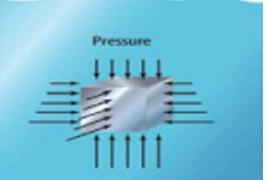
- Liquids exert pressure in all directions.
- Liquid pressure increases with depth.
- Depends on:
- Density of liquid
- Depth
- Acceleration due to gravity
Example:
- Dam walls are thicker at the bottom.
- Water pipe bursts outward.
(C) Pressure in Gases
- Gases exert pressure in all directions.
- Gases are compressible.
- Air pressure surrounds us.
Example:
- Balloon expands when filled with air.
- Wind pushes objects.
3. Fluids and Their Behavior
Liquids and gases are called fluids because they can flow.
Fluids exert pressure on:
- Bottom
- Walls
- Any object immersed in them
Example:
A balloon under water experiences upward push due to water pressure.
4. Transmission of Pressure in Fluids
In Solids
- Molecules are tightly packed.
- Pressure does not spread uniformly.
In Liquids and Gases
- Molecules can move.
- Pressure applied at one point spreads equally in all directions.
Important Point
- Liquids are nearly incompressible → transmit pressure effectively.
- Gases are compressible → need compression before effective transmission.
5. Pascal’s Law
Definition
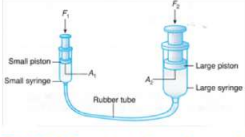
When pressure is applied at one point in an enclosed liquid, it is transmitted equally in all directions.
Formula
F1/A1 = F2/A2
Where:
- (F1) = Force applied on small piston
- (A1) = Area of small piston
- (F2) = Force on large piston
- (A2) = Area of large piston
If (A2) is larger, then (F2) becomes larger.
6. Hydraulic Machines
Hydraulic machines work on Pascal’s law.
They use:
- Two pistons
- A connecting pipe
- Non-compressible liquid (oil)
Small force → Large force output
Hydraulic Machine Formula
F2=F1×A1A2
Force multiplication occurs because the area of the output piston is larger.
Types of Hydraulic Machines
1. Hydraulic Lift
Used in:
- Car workshops
- Dentists’ chairs
Small force lifts heavy loads.
2. Hydraulic Brake
Used in vehicles.
Brake pedal → pressure in brake fluid → large force at brake pads → vehicle stops.
3. Hydraulic Jack
Used to lift cars by pumping oil.
4. Hydraulic Press
Used to:
- Compress materials
- Shape metals
- Punch holes
7. Upthrust (Buoyant Force)
Definition
Upthrust is the upward force exerted by a fluid on an immersed object.
SI Unit
Newton (N)
Cause of Upthrust
- Pressure increases with depth.
Bottom of object experiences more pressure than top.
This creates a net upward force.
Examples
- Empty bottle floats → Upthrust > weight
- Filled bottle sinks → Weight > upthrust
- Bucket feels lighter in water
- Airplane gets lift from air (fluid)
Real Weight and Apparent Weight
- Real weight = Weight in air
- Apparent weight = Weight in water
Upthrust=Real weight−Apparent weight
8. Differences
Pressure in Solids, Liquids and Gases
| Property | Solids | Liquids | Gases |
|---|---|---|---|
| Molecules | Very close | Less close | Very far |
| Pressure direction | Downward only | All directions | All directions |
| Compressible | No | Almost no | Yes |
| Pressure transmission | No | Yes | Yes (after compression) |
Hydraulic Machines vs Normal Machines
| Hydraulic Machine | Normal Machine |
|---|---|
| Uses liquid | Uses mechanical parts |
| Based on Pascal’s law | Based on mechanical advantage |
| Easily multiplies force | Limited force multiplication |
Important Exam Points
- Pressure = Force / Area
- Liquid pressure increases with depth
- Pascal’s law is the principle behind hydraulic machines
- Liquids are incompressible
- Upthrust occurs due to difference in pressure
- Objects float when upthrust ≥ weight
Gallery

Transmission of Pressure in Fluid
Transmission of Pressure in Fluid
Hydraulic Machine
Hydraulic Machine
Direction of upthrust
Direction of upthrust