1.Introduction & Review
Compare figures by overlapping, area, and congruency.
Questions to discuss:
Do pairs of figures match when overlapped?
Are their areas equal?
Which figures are congruent and which are not?
Do all figures with equal area have to be congruent?
Observation: Congruency ≠ equal area necessarily, but equal area ≠ congruency.
2.Area of Parallelograms and Triangles
2.1 Theorems
Theorem 1: Parallelograms on the same base and between the same parallels have equal area [Fig1]
Given: Parallelograms ABCD and ABEF on same base AB and between parallel lines AB and CF.
To Prove: Area of ABCD = Area of ABEF
Proof Idea:
1.Triangles formed by diagonals are congruent (AAS).
2.Adding the same trapezium to both sides → Areas equal.
3.Hence, parallelograms on the same base and between the same parallels are equal in area.
Formula for Area of Parallelogram: Area = base × height
Example 1: Rectangle ABPQ and parallelogram ABCD on same base AB and parallel lines → Area of ABCD = Area of ABPQ
Theorem 2: Area of a triangle = ½ area of parallelogram on the same base and between same parallels[FIG 2]
Given: Triangle DABE and parallelogram ABCD on same base AB and parallel lines.
To Prove: Area of DABE = ½ Area of ABCD
Proof Idea:
Draw a parallelogram using the triangle as half → ABFE.
Triangle is half of this parallelogram.
Both parallelograms on same base → Area of triangle = ½ Area of parallelogram.
Formula for Area of Triangle: Area = ½ × base × height
Example 2: Triangle with base 8 cm and height 6 cm → Area = 24 cm²; parallelogram on same base and height → Area = 48 cm²
Theorem 3: Triangles on the same base and between same parallels are equal in area [Fig 3]
Given: Triangles ABE and ABC on base AB and parallel lines.
To Prove: Area of ABE = Area of ABC
Proof Idea:
Construct parallelogram ABCD with triangles sharing the same base.
Diagonal divides parallelogram into two triangles of equal area.
Hence, triangles with same base and between same parallels → equal area.
3.Midpoint Theorems
Line joining midpoints of two sides of a triangle is parallel to third side and half its length.
Joining midpoints of a quadrilateral forms a parallelogram (Varignon Theorem).
Area of this midpoint parallelogram = ½ area of original
Example 3: Parallelogram ABCD, midpoints E, F, G, H → Area of EFGH = ½ Area of ABCD
4.Relations Between Figures
| Relation | Observation / Formula |
|---|---|
| Parallelogram on same base & between same parallels | Areas are equal |
| Triangle on same base & between same parallels | Area of triangle = ½ area of parallelogram |
| Triangles on same base & between same parallels | Areas are equal |
| Quadrilateral formed by joining midpoints of any quadrilateral | Forms smaller parallelogram, area = ½ of original |
5.Examples & Problems
5.1 Parallelograms
ABCD and ABEF: Base = 7 cm, height = 3 cm → Area = 21 cm² each
Rectangle vs Parallelogram: Same base & parallel lines → Areas equal
5.2 Triangles
Triangle base = 8 cm, height = 6 cm → Area = 24 cm²
Parallelogram same base & height → Area = 48 cm² → Triangle = ½ parallelogram
5.3 Triangles inside Parallelogram
ABCD parallelogram, triangles ΔAPB + ΔPCD → ½ Area of ABCD
PQRS parallelogram, triangles ΔPQY = ΔQRX → Equal area
5.4 Midpoints
ABCD parallelogram, midpoints M, N of BC, AD → MN divides ABCD into 2 equal parallelograms
Triangles standing on same base & between same parallels → Equal area
6.Key Formulas
Area of Parallelogram = base × height
Area of Triangle = ½ × base × height
Trapezium = ½ × (sum of parallel sides) × height
Midpoint parallelogram = ½ area of original
7.Important Notes for Students
Equal area ≠ congruency
Base and perpendicular height are crucial for calculating area
Diagonals divide parallelogram into equal triangles → shortcut in proofs
Use midpoints to form smaller parallelograms → Varignon theorem
Triangles between same parallels & on same base are always equal in area
Parallelograms on same base & between same parallels → equal area
Triangle = ½ parallelogram on same base & between same parallels
Important Questions – Area of Parallelograms, Triangles, and Quadrilaterals
1.Parallelograms on Same Base and Between Same Parallels
Q1: Parallelograms ABCD and ABEF have the same base AB and lie between the same parallels AB and CF. Find the area of both and prove they are equal.
Solution:
Base AB = 7 cm, Height = 3 cm
Area of ABCD = base × height = 7 × 3 = 21 cm²
Area of ABEF = base × height = 7 × 3 = 21 cm²
Hence, Area of ABCD = Area of ABEF.
Concept: Parallelograms on same base and between same parallels are always equal in area.
Q2: ABPQ is a rectangle and ABCD is a parallelogram on the same base AB and between the same parallels. Prove their areas are equal.
Solution:
Area of ABCD = AB × height = base × height
Area of ABPQ = length × breadth = AB × height
Hence, Area of ABCD = Area of ABPQ.
Concept: Same base and same height → areas equal.
2.Triangle and Parallelogram on Same Base
Q3: Triangle DABE has base AB = 8 cm and height AE = 6 cm. Parallelogram ABCD has same base and height. Find the area of triangle and parallelogram, and relation between them.
Solution:
Area of triangle DABE = ½ × base × height = ½ × 8 × 6 = 24 cm²
Area of parallelogram ABCD = base × height = 8 × 6 = 48 cm²
Relation: Area of triangle = ½ area of parallelogram
Q4: Prove that triangle standing on same base and between same parallels = ½ parallelogram area.
Solution:
Construct a parallelogram using triangle → ABFE
Triangle = ½ parallelogram → ABFE
Parallelogram ABFE = ABCD → Triangle = ½ Area of ABCD
Hence proved.
3.Triangles on Same Base and Between Same Parallels
Q5: Prove that triangles ABE and ABC on base AB and between same parallels are equal in area.
Solution:
Construct parallelogram ABCD using triangles
Diagonal AC divides ABCD into 2 equal triangles → Area of ΔABE = Area of ΔABC
Hence, triangles on same base & between same parallels = equal area
Q6: In parallelogram ABCD, prove that ΔAPB + ΔPCD = ½ area of ABCD.
Solution:
Draw line MN through point P parallel to CD
ABNM and MNCD are parallelograms
Area of ΔAPB = ½ area of ABNM
Area of ΔPCD = ½ area of MNCD
Add → Area of ΔAPB + ΔPCD = ½ area of ABCD
4.Midpoint Theorems
Q7: ABCD is a parallelogram. E, F, G, H are midpoints of sides. Prove area of EFGH = ½ area of ABCD.
Solution:
Join midpoints → forms parallelogram EFGH (Varignon Theorem)
Each small triangle = ½ of its respective half-parallelogram
Area of EFGH = ½ (area of ABCD)
Q8: ABCD parallelogram, M and N are midpoints of BC and AD. Prove that MN divides ABCD into 2 equal parallelograms.
Solution:
MN joins midpoints → parallel to base → forms 2 equal parallelograms
Area of ABMN = Area of CDNM → proved
5.Parallelogram and Triangle Examples
Q9: PQRS parallelogram. Triangles ΔPQY and ΔQRX formed by points on PS and SR. Prove they are equal in area.
Solution:
Triangles share same base and parallel height
Area of ΔPQY = ½ area of PQRS
Area of ΔQRX = ½ area of PQRS
Hence, Area ΔPQY = Area ΔQRX
Q10: Parallelogram PQRS, SR extended to T, PT intersects QR at O. Prove Area ΔPQO = Area ΔRTO.
Solution:
Draw diagonal PR → divides into triangles with equal area on same base & height
Use whole-part axiom to subtract common areas
Area ΔPQO = Area ΔRTO → proved
visit this link for further practice
https://besidedegree.com/exam/s/academic
Gallery
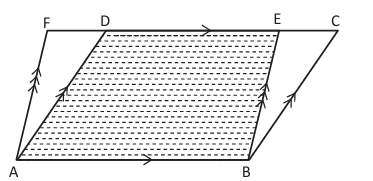
fig 1
fig 1
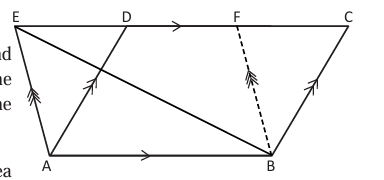
Fig 2
Fig 2
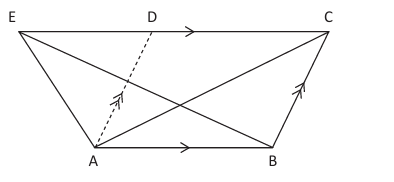
Fig 3
Fig 3