1.Definition of a Circle
A circle is the set of all points in a plane that are at a fixed distance from a fixed point.
The fixed point is called the center, and the fixed distance is called the radius.
Example: Circle with center O and radius r → all points P such that OP = r.
2.Parts of a Circle (Basic Concepts)
1.Center (O): The fixed point from which all points of the circle are equidistant.
2.Radius (r): A line segment joining the center to any point on the circle. All radii are equal.
3.Diameter (d): A line segment passing through the center with endpoints on the circle. Diameter = 2 × Radius.
4.Chord: A line segment joining any two points on the circle. Diameter is the longest chord.
5.Arc: A portion of the circle between two points. Minor arc = shorter portion, Major arc = longer portion.
6.Sector: The region enclosed by two radii and the arc between them.
7.Segment: The region enclosed by a chord and the arc above it.
8.Tangent: A line that touches the circle at exactly one point. Tangent is perpendicular to the radius at point of contact.
9.Secant: A line that intersects the circle at two points.
10.Circumference: The total distance around the circle. Formula: C = 2πr
11.Area of Circle: Area enclosed by the circle. Formula: A = πr²
3.Important Properties
1.All radii are equal.
2.A diameter divides a circle into two equal semicircles.
3.Perpendicular from center to a chord bisects the chord.
4.Chords equidistant from the center are equal.
5.Angle in a semicircle = 90°
Basic Properties of Chords
Property 1: A perpendicular drawn from the center of a circle to a chord bisects the chord.
If AB is a chord and O is the center, draw OM ⟂ AB. Then AM = MB.
Property 2: A line joining the center of the circle to the midpoint of a chord is perpendicular to the chord.
OM ⟂ AB, where M is midpoint of AB.
Property 3: Chords which are equidistant from the center of a circle are equal.
If chords AB and CD are both at distance ‘d’ from center O, then AB = CD.
Perpendicular from the Centre to a Chord
• A perpendicular from the centre to a chord always bisects the chord.
• If the centre joins the midpoint of a chord, the line is perpendicular to the chord.
• Chords equidistant from the centre are equal in length.
Central Angle and Circumference (Inscribed) Angle
• Central angle is made by two radii at the centre.
• Inscribed angle is made by two chords on the circle.
• Central angle equals its intercepted arc.
• Major arc > semicircle, minor arc < semicircle.
Relation Between Inscribed Angle and Its Arc
Theorem 1 (Central vs Inscribed Angle):
Statement: The inscribed angle standing on an arc = 1/2 of the central angle standing on the same arc.[Fig1]
Formula: ∠ACB = 1/2 ∠AOB
Proof:
1.Join O (center) to C (point on circle).
2.Consider ΔOAC and ΔOBC (isosceles triangles, OA = OC = OB).
3.Sum of angles in ΔOAC: ∠OAC + ∠OCA + ∠AOC = 180° → 2∠OCA = 180° – ∠AOC
4.Sum of angles in ΔOBC: 2∠OCB = 180° – ∠BOC
5.Add: 2(∠OCA + ∠OCB) = 360° – (∠AOC + ∠BOC) → 2∠ACB = ∠AOB
Special case: Angle in a semicircle = 90°
Theorem 2 (Angles on the Same Arc):
Statement: Inscribed angles standing on the same arc are equal.[fig 2]
Formula: ∠ACB = ∠ADB
Proof:
1.Let O be the center of the circle. Join O to points A and B.
2.Consider inscribed angles ∠ACB and ∠ADB standing on the same arc AB.
3.Using Theorem 1 (Central vs Inscribed Angle):
4.Central angle ∠AOB = 2 ∠ACB
5.Central angle ∠AOB = 2 ∠ADB
6.Equate the two: 2∠ACB = 2∠ADB → ∠ACB = ∠ADB
Conclusion: Inscribed angles standing on the same arc are always equal.
Cyclic Quadrilateral
Theorem 3 (Opposite angles):
Opposite angles of a cyclic quadrilateral are supplementary. [fig 3]
∠ABC + ∠ADC = 180°
∠BAD + ∠BCD = 180°
Proof Idea:
1.Use central angle and inscribed angle relations.
2.Sum of angles around center O = 360° → divide by 2 → 180°
Intersection of Chords Inside a Circle
• When two chords intersect, their opposite angles stand on equal arcs.
• Helps in finding unknown angles.
Angle Standing on the Diameter
• Any angle standing on a diameter is always a right angle (90°).
• Used to identify right triangles in circle-based questions.
Five Important Solved Questions
1. In a circle, ∠PQR = 100°. Find ∠OPR.
Solution:
Central angle POR = 2 × 100° = 200°.
Acute POR = 360 – 200 = 160°.
In isosceles ΔPOR: 160 + 2x = 180 → x = 10°.
∠OPR = 10°.
2. In triangle ABC, ∠ABC = 74°, ∠ACB = 30°. Find ∠BDC.
Solution:
∠BAC = 180 – (74 + 30) = 76°.
Angle on same arc BC at point D gives ∠BDC = 76°.
3. AC and BD intersect at E in cyclic quadrilateral ABCD. If ∠BEC = 130° and ∠ECD = 20°, find ∠BAC.
Solution:
∠CED = 180 – 130 = 50°.
In ΔCED: ∠EDC = 180 – (50 + 20) = 110°.
Angle on same arc BC: ∠BAC = 110°.
4. In a cyclic quadrilateral, AB is extended to E. Prove ∠ADC = ∠CBE.
Reason:
Opposite ∠ADC + ∠ABC = 180°.
Straight line: ∠ABC + ∠CBE = 180°.
Therefore: ∠ADC = ∠CBE.
5. In a semicircle, angle ∠ACB touches the circumference. Show it is 90°.
Solution:
Central angle on diameter = 180°.
Inscribed angle = ½ × 180° = 90°.
Visit this link for further practice!!
https://besidedegree.com/exam/s/academic
Gallery
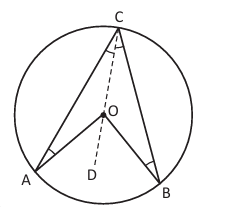
Fig 1
Fig 1
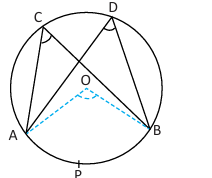
Fig 2
Fig 2
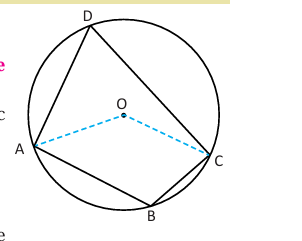
Fig 3
Fig 3