1.Review of Linear,Quadratic,and Cubic Equations
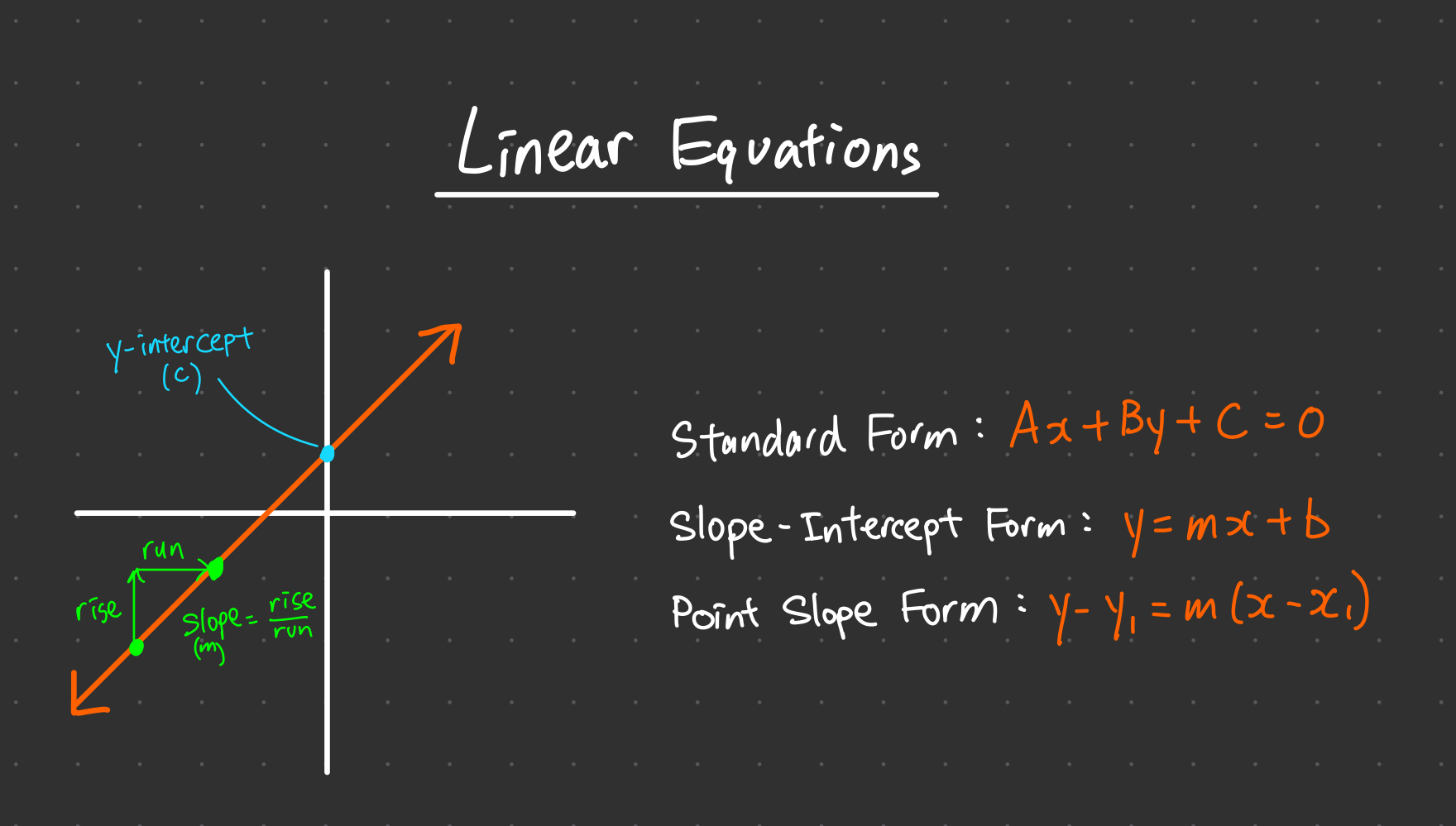
2.Linear Equations
Definition:
An equation of degree 1 (highest power of variable = 1).
General form:
ax + b = 0,a ≠ 0
Characteristics:
1.Graph:Straight line
2.Root:x = -b/a
3.Slope:m = -A/B (from Ax + By + C = 0)
4.Constant rate of change
Forms of Linear Equation:
1.Standard form: Ax + By + C = 0
2.Slope-intercept form: y = mx + c
3.Point-slope form: y - y₁ = m(x - x₁)
Example 1:
3x + 7 = 0
3x = -7
x = -7/3
Example 2:
2x + 5y = 10
5y = -2x + 10
y = -2/5 x + 2
Parallel and Perpendicular Lines:
1.Parallel lines have equal slopes
2.Perpendicular lines: m₁m₂ = -1
Graph Properties:
1.No turning point
2.No maximum or minimum
3.Domain:all real numbers
4.Range:all real numbers
3.Quadratic Equations
Definition:
Equation of degree 2 (highest power of variable = 2).
General form:
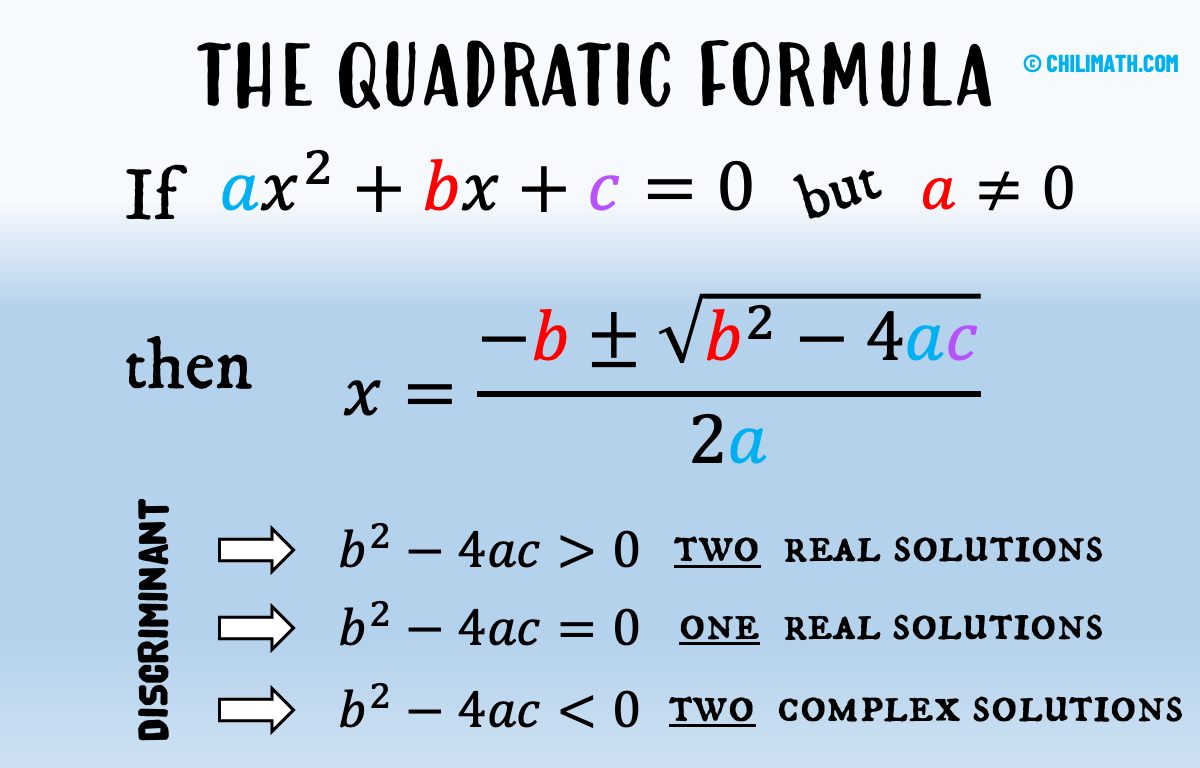
ax² + bx + c = 0,a ≠ 0
Characteristics:
1.Graph:Parabola
2.Vertex:x = -b/(2a)
3.Axis of symmetry :x = -b/(2a)
4.Discriminant:Δ = b² - 4ac
Nature of Roots:
1.Δ > 0 → two real and distinct
2.Δ = 0 → two real and equal
3.Δ < 0 → two complex
Sum and Product of Roots:
If roots are α and β:
1.α + β = -b/a
2.αβ = c/a
Forms of Quadratic Function:
1.Standard form :y = ax² + bx + c
2.Vertex form :y = a(x - h)² + k
3.Factored form :y = a(x - p)(x - q)
Maximum and Minimum Value:
1.Minimum if a > 0
2.Maximum if a < 0
3.Value occurs at x = -b/(2a)
Completing the Square Example:
x² + 4x + 1 = 0
x² + 4x = -1
x² + 4x + 4 = 3
(x + 2)² = 3
x = -2 ± √3
Quadratic Inequalities:
1.Solve equation first
2.Test intervals
3.Use sign of parabola
Graph Properties:
1.Domain:all real numbers
2.Range:y ≥ minimum or y ≤ maximum
3.Symmetric about vertical line
4.Cubic Equations
Definition:
Equation of degree 3 (highest power of variable = 3).
General form:
ax³ + bx² + cx + d = 0
Characteristics:
1.Graph:S-shaped curve
2.Maximum three real roots
3.At least one real root
4.Has point of inflection
Sum and Product of Roots:
If roots are α,β,γ:
1.α + β + γ = -b/a
2.αβ + βγ + γα = c/a
3.αβγ = -d/a
Special Identities:
1.a³ + b³ = (a + b)(a² - ab + b²)
2.a³ - b³ = (a - b)(a² + ab + b²)
3.(a + b)³ = a³ + 3a²b + 3ab² + b³
Example:
x³ - 8 = 0
x³ - 2³ = 0
(x - 2)(x² + 2x + 4) = 0
x = 2
Graph Properties:
1.Domain:all real numbers
2.Range:all real numbers
3.No line of symmetry in general
5.Comparison of Linear,Quadratic,and Cubic
| Property | Linear | Quadratic | Cubic |
|---|---|---|---|
| Degree | 1 | 2 | 3 |
| Maximum number of roots | 1 | 2 | 3 |
| Shape of graph | Straight line | Parabola | S-shaped curve |
| Turning points | None | One | Up to two |
6.Real Life Applications
Linear:
1.Speed-distance problems
2.Simple interest
3.Cost calculations
Quadratic:
1.Projectile motion
2.Area optimization
3.Maximum profit problems
Cubic:
1.Volume problems
2.Engineering design
3.Population models
7.Common Mistakes to Avoid
1.Forgetting a ≠ 0
2.Sign errors in quadratic formula
3.Not checking common factors
4.Not testing simple roots in cubic equations
5.Forgetting ± when taking square roots1.5.0 Review of Linear, Quadratic, and Cubic Equations
8. Important Questions and Solutions
Q1. Solve the linear equation:
3x - 7 = 0
Solution:
3x - 7 = 0
3x = 7
x = 7/3
Q2. Solve the quadratic equation:
x² - 5x + 6 = 0
Solution (Factorization):
x² - 5x + 6 = 0
(x - 2)(x - 3) = 0
x = 2 or x = 3
Solution (Quadratic Formula):
x = [-(-5) ± √((-5)² - 4·1·6)] / (2·1)
x = [5 ± √(25 - 24)] / 2
x = [5 ± 1] / 2
x = 3 or x = 2
Q3. Solve using completing the square:
x² + 6x + 5 = 0
Solution:
x² + 6x + 5 = 0
x² + 6x = -5
x² + 6x + 9 = 4 (added (6/2)² = 9)
(x + 3)² = 4
x + 3 = ±2
x = -1 or x = -5
Q4. Solve the cubic equation:
x³ - x² - 4x + 4 = 0
Solution (Factor by grouping):
(x³ - x²) - (4x - 4) = 0
x²(x - 1) - 4(x - 1) = 0
(x² - 4)(x - 1) = 0
(x - 2)(x + 2)(x - 1) = 0
x = 2, x = -2, x = 1
Q5. Find the vertex of the quadratic function:
y = 2x² - 8x + 5
Solution:
x-coordinate = -b/(2a) = 8/(4) = 2
y-coordinate = 2(2)² - 8(2) + 5 = -3
Vertex = (2, -3)
Q6. Determine the nature of roots using discriminant:
2x² - 4x + 2 = 0
Solution:
Δ = b² - 4ac = (-4)² - 4(2)(2) = 16 - 16 = 0
Nature of roots: Two real and equal roots
x = [-b ± √Δ]/(2a)
x = [4 ± 0]/(4) = 1
Roots = 1, 1
Q7. Solve the quadratic inequality:
x² - 3x - 10 ≤ 0
Solution:
Factorize: (x - 5)(x + 2) ≤ 0
Roots: x = 5, x = -2
Test intervals:
For x < -2: (-)(-) > 0 → Not ≤ 0
For -2 ≤ x ≤ 5: (-)(+) ≤ 0 → True
For x > 5: (+)(+) > 0 → Not ≤ 0
Solution: -2 ≤ x ≤ 5
Q8. Solve using sum and product of roots:
x² - 7x + 12 = 0
Solution:
Sum of roots α + β = 7
Product of roots αβ = 12
Factorization: (x - 3)(x - 4) = 0
x = 3 or x = 4
For further practice visit this link !!
https://besidedegree.com/exam/s/academic