1. Introduction to ICT
Information and Communication Technology (ICT) refers to technologies used for communication, data sharing, information processing, and economic development.
ICT helps in:
- Fast communication
- Information sharing
- Education, business, banking, health
- E-governance and development
Telecommunication
Transmission of data or information from one place to another using electronic means.
Examples:
- Mobile phone
- Internet phone
- Television
- Radio
- Landline telephone
History of ICT
World
1950–1980: Electronic Data Processing (EDP) used in developed countries
Used mainly for calculations and record keeping
Nepal
1974: National Computer Center (NCC) established
1995 onward: Computers used in:
- Banking
- Hotel booking
- Air ticketing
- Email and Internet services
2. Communication
Communication is the process of sending and receiving data or information between two or more people or devices.
Elements of Communication
- Sender
- Message (Data)
- Medium
- Receiver
- Feedback
2.1 Data Communication Modes
| Mode | Description | Example |
|---|---|---|
| Simplex | One-way communication only | TV, Radio |
| Half Duplex | Two-way communication, one direction at a time | Walkie-talkie |
| Full Duplex | Two-way communication simultaneously | Mobile phone call |
3. Components of Data Communication
- Data (Message) – Information to send.
- Sender – Device sending data.
- Medium – Channel connecting devices.
- Receiver – Device receiving data.
- Protocol – Rules followed during communication.
4. Communication Media
Communication media is the path through which data is transmitted.
4.1 Guided (Wired) Media
a) Twisted Pair Cable
Two copper wires twisted together
Types:
- UTP: Cheap, up to 100m, low bandwidth
- STP: Shielded, high bandwidth
- Connector: RJ-45
b) Coaxial Cable
- Inner conductor + outer shield
- Better bandwidth than twisted pair
- Connectors: BNC, T-connector
c) Fiber Optic Cable
- Uses light signals
- Very high speed
- Immune to electromagnetic interference
- Connectors: ST, SC, SMA
4.2 Unguided (Wireless) Media
a) Radio Waves
Used in radio, TV, mobile communication
Types: AM, FM, PM
b) Microwave
Line-of-sight transmission
Requires towers and repeaters
c) Satellite Communication
Uses artificial satellites
Global coverage
5. Computer Network
A computer network is the interconnection of two or more computers to share data, hardware, software, and resources.
5.1 Advantages
Resource sharing
Fast communication
Centralized backup
Internet access
5.2 Disadvantages
Virus and malware risk
Cybercrime
High setup cost
Needs skilled administrator
5.3 Network Devices
| Device | Function |
|---|---|
| NIC (Network Interface Card) | Connects a computer to a network |
| Hub | Broadcasts data to all connected devices |
| Switch | Sends data only to the intended device |
| Bridge | Connects similar networks |
| Router | Connects different networks |
| Gateway | Connects networks using different protocols |
| Repeater | Boosts or regenerates weak signals |
| Modem | Converts digital signals to analog and vice versa |
| Firewall | Protects network from unauthorized access |
| Access Point | Provides wireless connection to devices |
5.4 Bandwidth
Bandwidth is the amount of data transmitted per second.
Measured in bps (bits per second).
Higher bandwidth = faster data transfer.
6. Network Software
Network Operating System (NOS)
Software used to manage network resources.
Examples:
- Windows NT
- Linux
- Novell NetWare
Functions:
- User management
- File and printer sharing
- Security control
Protocol
A protocol is a set of rules for data communication.
Examples:
- TCP/IP
- HTTP
- FTP
- SMTP
- POP
7. Types of Networks
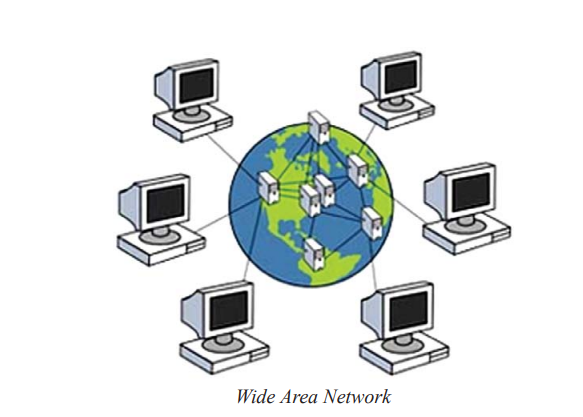
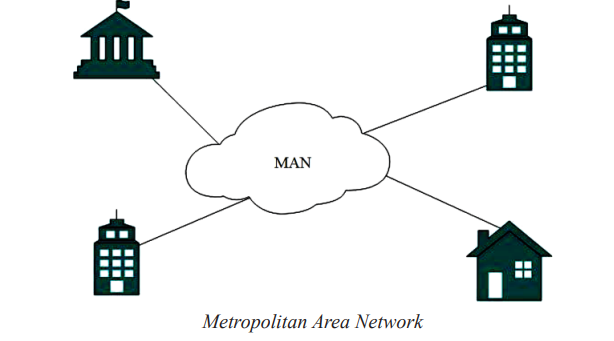
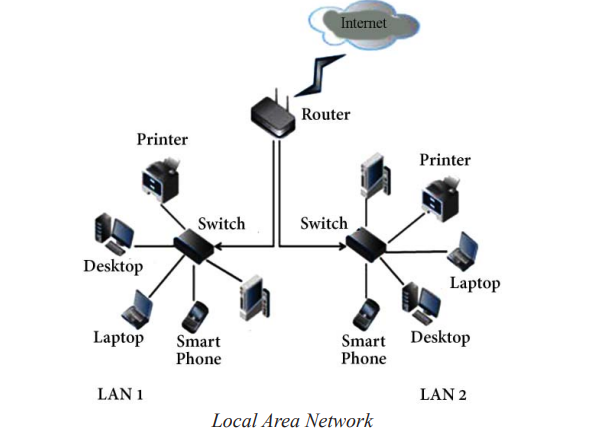
| Type | Coverage Area | Example |
|---|---|---|
| LAN (Local Area Network) | Small area (room, building, school lab) | School computer lab |
| MAN (Metropolitan Area Network) | City or metropolitan area | Cable TV network |
| WAN (Wide Area Network) | Large area, worldwide | Internet |
8. Network Architecture
Peer-to-Peer (P2P)
Equal nodes, decentralized, no server.
Advantage: Easy sharing, no admin needed.
Disadvantage: Low security, difficult backup.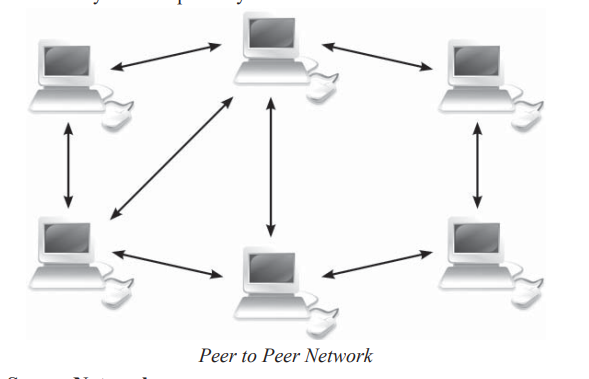
Client-Server
Central server provides resources.
Advantage: Centralized backup, better security.
Disadvantage: High cost, needs admin.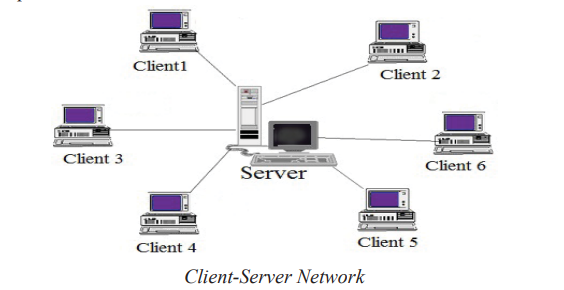
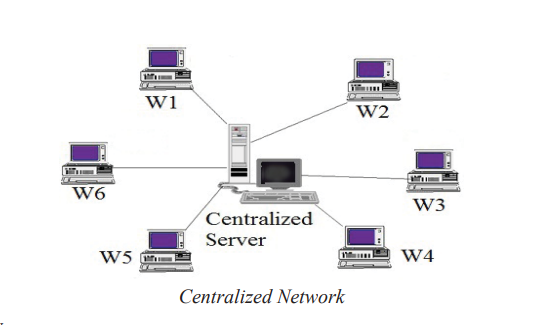
Centralized Network
Host computer does processing; workstations only for I/O.
Advantage: Cost-effective, secure data.
Disadvantage: Host failure affects all.
9. Network Topologies
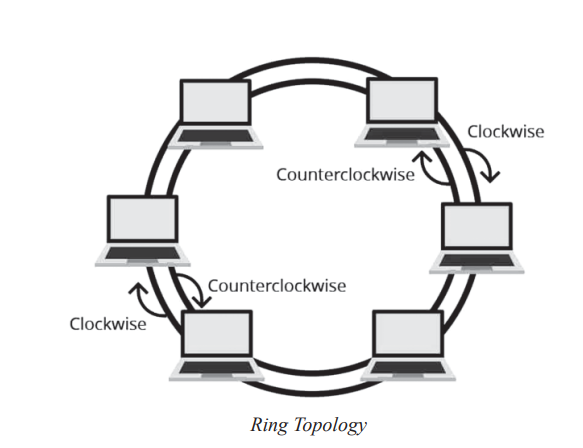
| Topology | Advantage | Disadvantage |
|---|---|---|
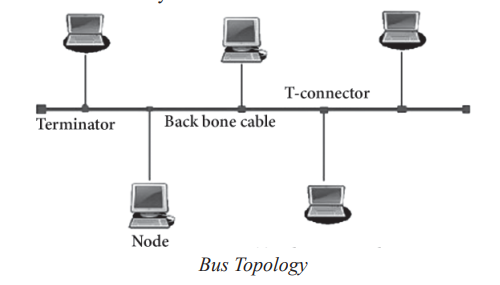
| Bus | Cheap, uses less cable | If main cable fails, entire network stops |
| Ring | Handles heavy traffic well | Failure of one device affects whole network |
| Star | Fast, easy to troubleshoot | Hub/switch failure stops entire network |
failure stops network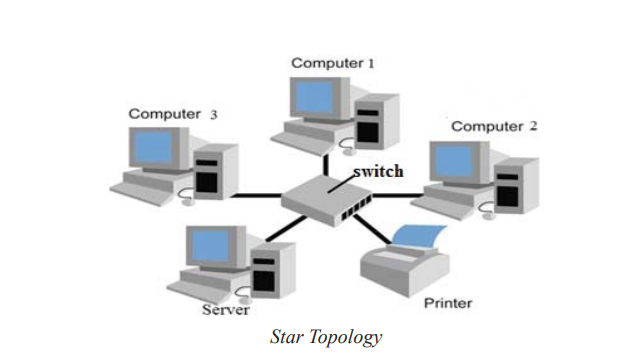
10. Internet & Its Services
Definition: Global network of networks using TCP/IP.
History: ARPANET 1969 → Worldwide 1992 → Nepal 1994.
Services
- WWW (World Wide Web) – Hyperlinked multimedia documents.
- Email – Fast global communication with attachments.
- Telnet – Remote computer access.
- FTP – File transfer between computers.
- Search Engine – Finds information using keywords (Google, Yahoo).
- IRC/Chat/Video Conference – Real-time communication.
- Online Banking – Conduct financial transactions online.
- E-commerce – Buying/selling goods/services online (B2B, B2C, C2C, C2B).
11. Important Terms
- Duplex Mode – Two-way data transmission.
- Protocol – Rules for network communication.
- Fiber Optic Cable – Light-based data transmission.
- Radio Wave – Electromagnetic wave for wireless communication.
- Repeater – Boosts signals for long-distance transfer.
- Computer Network – Interconnection of multiple computers.
- Hub – Connects multiple devices; broadcasts data.
- Router – Connects multiple networks.
- Network Software – Manages network.
- Internet – Network of networks.
- Email – Sending/receiving electronic messages.