1. Gravitation
Definition: Gravitation is the force of attraction between any two objects in the universe.
Observed by Newton when an apple fell from a tree; led to the Universal Law of Gravitation (1687).
Newton’s Universal Law of Gravitation
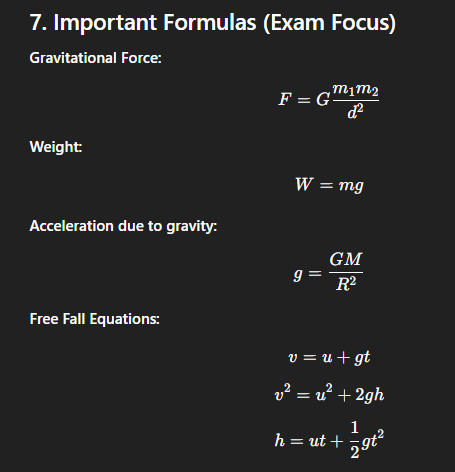
The gravitational force (FFF) between two bodies is:
- f= G m1m2/d*2
Where:
F = gravitational force between the two bodies
m₁, m₂ = masses of the objects
d = distance between the centers of the two objects
G = gravitational constant
Observations:
- Doubling one mass → force doubles.
- Doubling both masses → force quadruples.
- Doubling distance → force becomes 1/4.
- Halving distance → force becomes 4×.
Consequences:
- Keeps planets in orbit around the Sun.
- Causes tides (Moon’s gravitational effect on oceans).
- Keeps objects on Earth’s surface.
2. Gravity & Weight
Mass (m): Amount of matter in an object (kg) → does not change with location.
Weight (W): Force due to gravity on a mass → changes with location.
- W=mg
SI unit: Newton (N)
Vector quantity → points toward the center of the planet.
Key Points:
Weight is directly proportional to mass: W∝m
Weight is directly proportional to acceleration due to gravity: W∝g
Examples of variation:
- Earth poles (g = 9.83 m/s²) → weight more
- Earth equator (g = 9.78 m/s²) → weight less
- Moon (g = 1.62 m/s²) → weight ~1/6 of Earth
3. Acceleration Due to Gravity (g)
Denoted by g
Responsible for objects falling toward a planet (free fall)
Formula (from Newton’s Law of Gravitation)
g=GMR2g = \frac{GM}{R^2}g=R2GM
Where:
G = Gravitational constant
M = Mass of the planet
R = Radius of the planet
Important Points
Depends on the mass (M) and radius (R) of the planet
Independent of the mass of the falling object
(Heavy stone and light stone fall with the same acceleration, ignoring air resistance.)
Value of g on Earth
Average value:
g=9.81 m/s2
At polar regions:
g≈9.83 m/s2
(Slightly higher)
At equator:
g≈9.78 m/s2
(Slightly lower)
Variation with Height
As height from Earth’s surface increases, g decreases
Example:
At the International Space Station (about 400 km above Earth)
g≈8.66 m/s2
So astronauts are not floating because there’s no gravity. They’re floating because they’re in continuous free fall. Physics loves plot twists.
Comparison
Moon:
g=1.62 m/s2
About 6 times less than Earth
Which is why you’d jump like a superhero there, assuming you survive the whole no-atmosphere situation.
4. Free Fall
Definition
Free fall is the motion of an object under the influence of gravity alone, ignoring air resistance.
In vacuum, all objects fall with the same acceleration (g).
Independent of mass.
Experiments
Galileo’s Leaning Tower Experiment
Heavy and light objects fall together.
Feather and Coin Experiment
In vacuum, both fall at the same rate.
Equations of Motion for Free Fall:
v=u+ gt
v2=u2+2gh
h=ut+12gt2
Where:
u = initial velocity
v = final velocity
g = acceleration due to gravity
t = time
h = height or distance fallen
Weightlessness:
During free fall (like astronauts in orbit), objects experience zero apparent weight because everything is falling together.
5. Mass, Weight & Other Planets
Mass = constant everywhere; weight = depends on g.
Formula for weight on another planet:
- W=mg planet
Example: Lifting 100 kg on Earth → can lift 601 kg on Moon (g = 1.63 m/s²)
Weight comparison table (examples):
Weight Comparison Table
| Object Mass | Earth (9.81 m/s²) | Moon (1.62 m/s²) | Mars (3.75 m/s²) | Venus (8.83 m/s²) |
|---|---|---|---|---|
| 50 kg | 490 N | 81 N | 187.5 N | 441.5 N |
6. Parachutes & Air Resistance
- Free fall → acceleration = g
- Parachute fall: air resistance balances weight → uniform speed
- Moon → no atmosphere → parachute cannot slow descent → free fall → dangerous landing
- Seeds, hail, and parachutes demonstrate effect of air resistance
7. Shortcut Observations:
Doubling mass → force doubles
Doubling distance → force 1/4
g decreases with height, increases toward poles
Free fall acceleration independent of mass
8. Quick Conceptual Points
- Gravitational force is universal → acts between all objects
- Mass = matter, scalar; Weight = force, vector
- Free fall possible only if air resistance negligible
- Astronauts feel weightless in orbit because all fall together
- g on planets depends on mass and radius
Gallery
Important Formulas
Important Formulas