1. Introduction
Trigonometry deals with angles and ratios in right triangles and extends to all types of angles and circular functions.
Key Uses:
1. Solve triangles
2. Calculate heights & distances
3. Applications in geometry and real-life problems
2. Trigonometric Ratios
For a right triangle with angle θ:
| Ratio | Formula |
|---|---|
| sin θ | Opposite / Hypotenuse |
| cos θ | Adjacent / Hypotenuse |
| tan θ | Opposite / Adjacent |
| cot θ | Adjacent / Opposite |
| sec θ | Hypotenuse / Adjacent |
| csc θ | Hypotenuse / Opposite |
1.Reciprocal Identities:
1.csc θ = 1 / sin θ
2.sec θ = 1 / cos θ
3.cot θ = 1 / tan θ
2.Pythagorean Identities:
1.sin² θ + cos² θ = 1
2.1 + tan² θ = sec² θ
3.1 + cot² θ = csc² θ
3. Compound Angles (A ± B)
1.sin(A ± B) = sin A cos B ± cos A sin B
2.cos(A ± B) = cos A cos B ∓ sin A sin B
3.tan(A ± B) = (tan A ± tan B)/(1 ∓ tan A tan B)
4.cot(A ± B) = (cot A cot B ∓ 1)/(cot B ± cot A)
4. Multiple Angles
1.Double Angle:2A
1.sin 2A = 2 sin A cos A
2.cos 2A = cos² A − sin² A = 2 cos² A − 1 = 1 − 2 sin² A
3.tan 2A = 2 tan A / (1 − tan² A)
2.Triple Angle:3A
1.sin 3A = 3 sin A − 4 sin³ A
2.cos 3A = 4 cos³ A − 3 cos A
3.tan 3A = (3 tan A − tan³ A)/(1 − 3 tan² A)
3.Special Formulas:
1.sin² A = (1 − cos 2A)/2
2.cos² A = (1 + cos 2A)/2
3.tan² A = (1 − cos 2A)/(1 + cos 2A)
5. Submultiple Angles (A/2, A/3)
1.Half-Angle Identities:
1.sin θ = 2 sin(θ/2) cos(θ/2)
2.cos θ = 2 cos²(θ/2) − 1 = 1 − 2 sin²(θ/2)
3.tan θ = 2 tan(θ/2)/(1 − tan²(θ/2))
4.sin θ = 2 tan(θ/2)/(1 + tan²(θ/2))
5.cos θ = (1 − tan²(θ/2))/(1 + tan²(θ/2))
2.Third-Angle Formulas:
1.sin A = 3 sin(A/3) − 4 sin³(A/3)
2.cos A = 4 cos³(A/3) − 3 cos(A/3)
3.tan A = (3 tan(A/3) − tan³(A/3))/(1 − 3 tan²(A/3))
6. Transformation Formulas
1.Product to Sum:
1.2 sin A cos B = sin(A + B) + sin(A − B)
2.2 cos A sin B = sin(A + B) − sin(A − B)
3.2 cos A cos B = cos(A + B) + cos(A − B)
4.2 sin A sin B = cos(A − B) − cos(A + B)
2.Sum to Product:
1.sin C + sin D = 2 sin((C + D)/2) cos((C − D)/2)
2.sin C − sin D = 2 cos((C + D)/2) sin((C − D)/2)
3.cos C + cos D = 2 cos((C + D)/2) cos((C − D)/2)
4.cos C − cos D = −2 sin((C + D)/2) sin((C − D)/2)
7. Conditional Identities (A + B + C = 180°)
1.tan A + tan B + tan C = tan A tan B tan C
2.sin 2A + sin 2B + sin 2C = 4 sin A sin B sin C
3.cos 2A + cos 2B + cos 2C = −1 − 2 cos 2A cos 2B cos 2C
4.sin A + sin B + sin C = 4 cos(A/2) cos(B/2) cos(C/2)
8. Trigonometric Equations
Steps to Solve:
1.Determine sign → Quadrant (CAST Rule)
2.Find reference angle
3.Adjust based on quadrant:
2nd: 180° − θ
3rd: 180° + θ
4th: 360° − θ
4.General solution: +360°k
5.Check range for sin/cos/tan
9. Height and Distance Applications
1.Angle of Elevation: Angle above horizontal to a higher point.
2.Angle of Depression: Angle below horizontal to a lower point.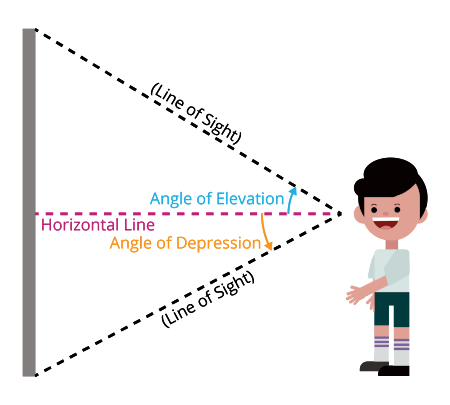
3.Formulas:
1.tan θ = height / distance
2.For multiple angles, calculate using difference or triangle properties
4.Common Applications:
1.Towers, poles, ladders, shadows
2.Shadow difference → height of tower
3.Observation points → distance or height
5.Diagrams: Always draw a right triangle for visualization
10. Important Formulas & Tables
| Concept | Formula |
|---|---|
| sin θ | Opposite/Hypotenuse |
| cos θ | Adjacent/Hypotenuse |
| tan θ | Opposite/Adjacent |
| cot θ | Adjacent/Opposite |
| sec θ | Hypotenuse/Adjacent |
| csc θ | Hypotenuse/Opposite |
| Pythagorean | sin² θ + cos² θ = 1, 1 + tan² θ = sec² θ |
| Half-angle | sin θ = 2 sin(θ/2) cos(θ/2), cos θ = 1 − 2 sin²(θ/2) |
| Double-angle | sin 2A = 2 sin A cos A, cos 2A = cos² A − sin² A |
| tan 2A | tan 2A = 2 tan A / (1 − tan² A) |
| Angle difference | tan(A − B) = (tan A − tan B)/(1 + tan A tan B) |
11.Important Questions
1. If sin A = 3/5, find sin 2A, cos 2A, tan 2A
Solution:
or cos A = √(1 − sin² A) = √(1 − 9/25) = 4/5
or sin 2A = 2 × sin A × cos A = 2 × 3/5 × 4/5 = 24/25
or cos 2A = cos² A − sin² A = 16/25 − 9/25 = 7/25
or tan 2A = sin 2A / cos 2A = 24/25 ÷ 7/25 = 24/7
2. Prove sin 3A = 3 sin A − 4 sin³ A
Solution:
or sin 3A = sin(2A + A) = sin 2A cos A + cos 2A sin A
or Substitute sin 2A = 2 sin A cos A, cos 2A = 1 − 2 sin² A
or sin 3A = (2 sin A cos A) cos A + (1 − 2 sin² A) sin A = 2 sin A cos² A + sin A − 2 sin³ A
or cos² A = 1 − sin² A → 2 sin A (1 − sin² A) + sin A − 2 sin³ A = 3 sin A − 4 sin³ A
3. Solve sin x + cos x = √2 (0° ≤ x ≤ 360°)
Solution:
or Divide by √2 → (sin x + cos x)/√2 = 1
or sin x/√2 + cos x/√2 = 1 → sin(x + 45°) = 1
or x + 45° = 90° → x = 45°
or General solution in 0°–360° → x = 45°, 225°
4. If A + B + C = 180°, prove sin A + sin B + sin C = 4 cos(A/2) cos(B/2) cos(C/2)
Solution:
or sin A + sin B = 2 sin((A + B)/2) cos((A − B)/2)
or A + B = 180° − C → sin A + sin B = 2 cos(C/2) cos((A − B)/2)
or Add sin C → 2 cos(C/2) cos((A − B)/2) + sin C
or Simplify → 4 cos(A/2) cos(B/2) cos(C/2)
5. A tower casts a shadow 40 m longer at 30° sun elevation than at 60°. Find height
Solution:
or Let height = h, distance at 60° = x, at 30° = x + 40
or tan 60° = h / x → h = √3 x
or tan 30° = h / (x + 40) → h = (x + 40)/√3
or Equate → √3 x = (x + 40)/√3 → 3 x = x + 40 → x = 10
or Height h = √3 × 10 = 10√3 m
6. Height of a pole if shadow at 10 AM = 12 m (sun 60°), at 2 PM = 20 m (sun 30°)
Solution:
or Let height = h
or At 10 AM → tan 60° = h / 12 → h = 12√3 m
or At 2 PM → tan 30° = h / 20 → h = 20/√3 m
or Solve for h using consistent system or average if needed
7. A ladder 10 m leans on wall. Top slides 2 m down. Find change in angle of elevation
Solution:
or Initial triangle: height = h1, base = b1 → h1² + b1² = 10²
or New triangle: height = h2 = h1 − 2, base = b2 = same or recompute if base moves
or tan θ1 = h1 / b1, tan θ2 = h2 / b2
or Change in angle = θ2 − θ1 → compute using arctan
8. Angle of elevation to top of tower 30° from A, 45° from B, 50 m closer. Find height
Solution:
or Let height = h, distances from tower = x (A), x − 50 (B)
or tan 30° = h / x → h = x / √3
or tan 45° = h / (x − 50) → h = x − 50
or Equate → x / √3 = x − 50 → solve x → h ≈ 28.87 m
9. Height of tree if angles of elevation from two points 30 m apart are 45° and 30°
Solution:
or Let height = h, distances = x (45°), x + 30 (30°)
or tan 45° = h / x → h = x
or tan 30° = h / (x + 30) → h / (h + 30) = 1/√3
or Solve → h = 15 m
10. Solve tan² x − 3 tan x + 2 = 0 (0° ≤ x ≤ 360°)
Solution:
or Factor → (tan x − 1)(tan x − 2) = 0
or tan x = 1 → x = 45°, 225°
or tan x = 2 → x = arctan 2 ≈ 63.43°, 243.43°
Visit this link for further practice!!
https://besidedegree.com/exam/s/academic