Quadratic Equations
1. Definition
A quadratic equation is an equation of the form:
ax² + bx + c = 0 (a ≠ 0)
It always has two roots (solutions).
2. Methods to Solve Quadratic Equations
A. Factorisation Method
Steps:
Split the middle term
Group terms and factor each group
Solve each factor = 0
Example:
x² − 7x + 12 = 0
Split middle term: x² − 4x − 3x + 12 = 0
Factor: x(x − 4) − 3(x − 4) = 0
(x − 4)(x − 3) = 0 → x = 4, 3
B. Completing the Square Method
Steps:
Make coefficient of x² = 1
Move constant term to RHS
Add (b/2)² to both sides
Write LHS as perfect square and solve
Example:
x² − 10x + 21 = 0
x² − 10x = −21
x² − 10x + 25 = −21 + 25 → (x − 5)² = 4
x − 5 = ±2 → x = 7, 3
C. Quadratic Formula Method (Works for all equations)
Formula:
x = [−b ± √(b² − 4ac)] / 2a
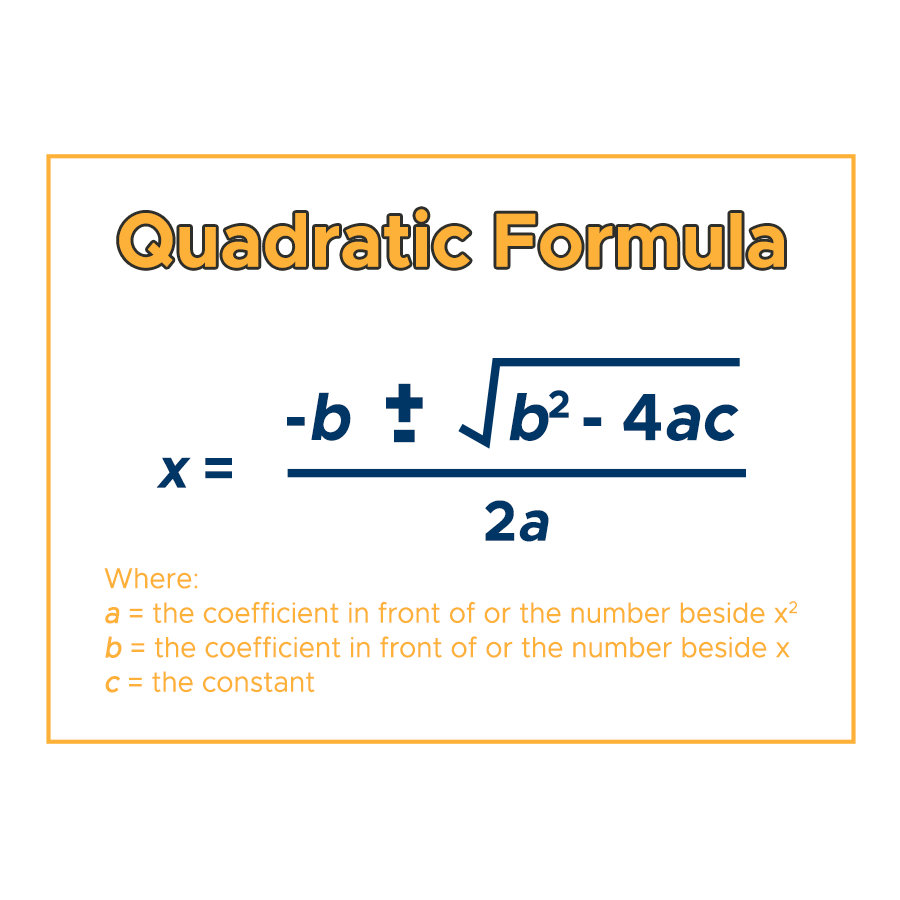
Discriminant: D = b² − 4ac
3. Nature of Roots (Important)
| Discriminant (D) | Nature of Roots |
|---|---|
| D > 0 | Two different real roots |
| D = 0 | Two equal real roots |
| D < 0 | No real roots (imaginary) |
4. Sum and Product of Roots
For ax² + bx + c = 0:
Sum of roots: α + β = −b / a
Product of roots: α × β = c / a
5. Word Problem Strategies
| Type of Problem | How to Form Equation | Example |
|---|---|---|
| Rectangle | Let breadth = x, length = x + k → x(x + k) = area | Area = 96, length = breadth + 4 → x(x + 4) = 96 → x² + 4x − 96 = 0 |
| Numbers & Square | Let number = x → x² ± x = given | Number + reciprocal = 5 → x + 1/x = 5 → x² − 5x + 1 = 0 |
| Sum & Product | Two numbers x, y → x + y = S, xy = P → x² − Sx + P = 0 | Sum of ages = 35, product = 306 → x² − 35x + 306 = 0 |
| Age Problems | Ages x and y, after/before k years → (x ± k)(y ± k) = product | |
| Two-digit Numbers | Number = 10x + y, use conditions to form equation | Product of digits = 12, number + 27 = reverse → number = 36 |
| Right Triangle | Sides x, y, hypotenuse h → x² + y² = h² | Hypotenuse = 25 m, difference of sides = 7 m → (x+7)² + x² = 625 |
| Perimeter/Area | Perimeter P, area A → l + b = P/2, l × b = A | |
| Picnic/Money | Total students n, absent k → total/(n−k) = amount + extra |
6. Most Important Solved Examples
Rectangle / Area Problems
Q1: Area = 120 m², length = breadth + 6
Solution:
x(x + 6) = 120
x² + 6x − 120 = 0
(x − 10)(x + 12) = 0
x = 10 (ignore negative)
Length = x + 6 = 16 m
Q2: Area = 168 m², length = 2 × breadth − 4
Solution:
x(2x − 4) = 168
2x² − 4x − 168 = 0
x² − 2x − 84 = 0
(x − 12)(x + 7) = 0
x = 12 (ignore negative)
Length = 2x − 4 = 20 m
Sum and Product of Numbers
Q3: Two numbers sum = 13, product = 40
Solution:
x² − 13x + 40 = 0
(x − 8)(x − 5) = 0
x = 8, 5
Q4: Two numbers sum = 12, difference of squares = 20
Solution:
x² − (12 − x)² = 20
24x − 144 = 20
x = 6.833 → 7
y = 12 − x = 5
Age Problems
Q5: Sum of ages = 27, product = 180
Solution:
x² − 27x + 180 = 0
(x − 12)(x − 15) = 0
x = 12, 15
Q6: Age difference = 4 years, product = 60
Solution:
(x + 4) × x = 60
x² + 4x − 60 = 0
(x − 6)(x + 10) = 0
x = 6 (ignore negative)
Older age = x + 4 = 10
Number + Reciprocal / Square Problems
Q7: Number + reciprocal = 7
Solution:
x + 1/x = 7
x² − 7x + 1 = 0
x = [7 ± √45]/2
Q8: Square of number + 3 × number = 70
Solution:
x² + 3x − 70 = 0
(x − 7)(x + 10) = 0
x = 7 (ignore negative)
Right Triangle / Pythagoras
Q9: Hypotenuse = 13, difference of sides = 5
Solution:
(x + 5)² + x² = 169
2x² + 10x − 144 = 0
x² + 5x − 72 = 0
(x − 8)(x + 9) = 0
x = 8
Other side = x + 5 = 13
Q10: One side = x, other = x + 3, hypotenuse = 15
Solution:
x² + (x + 3)² = 225
2x² + 6x − 216 = 0
x² + 3x − 108 = 0
(x − 9)(x + 12) = 0
x = 9
Other side = x + 3 = 12
Two-Digit Number Problems
Q11: Product of digits = 24, number − sum of digits = 54
Solution:
Let number = 10x + y
10x + y − (x + y) = 54 → 9x = 54 → x = 6
y = 24 / 6 = 4
Number = 10x + y = 64
Q12: Number + reverse = 99, product of digits = 20
Solution:
x + y = 9 → xy = 20
x² − 9x + 20 = 0
(x − 5)(x − 4) = 0
x = 5, y = 4
Number = 54
Consecutive Numbers / Squares
Q13: Sum of squares = 365
Solution:
x² + (x + 1)² = 365
2x² + 2x − 364 = 0
x² + x − 182 = 0
(x − 13)(x + 14) = 0
x = 13 → Numbers = 13, 14
Q14: Product of two consecutive even numbers = 168
Solution:
x(x + 2) = 168
x² + 2x − 168 = 0
(x − 12)(x + 14) = 0
x = 12 → Numbers = 12, 14
Visit this link for further practice
https://besidedegree.com/exam/25/preview