1.Introduction to Coordinate Geometry
Coordinate Geometry connects algebra and geometry, allowing us to represent points, lines, and curves using algebraic equations.
1.1.Cartesian Plane
1.X-axis → horizontal line
2.Y-axis → vertical line
3.Origin → intersection of X and Y axes (0,0)
1.2.Quadrants
| Quadrant | Sign of x | Sign of y |
|---|---|---|
| I | + | + |
| II | - | + |
| III | - | - |
| IV | + | - |
1.3.Distance Formula
Distance between A(x₁,y₁) and B(x₂,y₂):
AB = √[(x₂−x₁)² + (y₂−y₁)²]
1.4.Midpoint / Section Formula
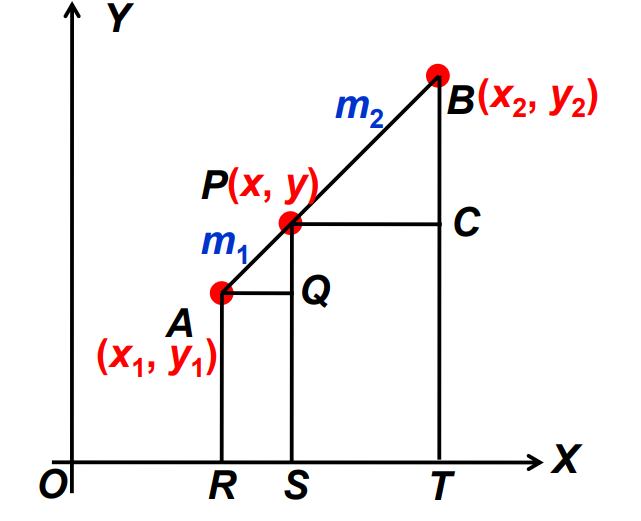
Midpoint of AB = ((x₁+x₂)/2 , (y₁+y₂)/2)
2.Straight Lines
A straight line is the shortest path between two points.
2.1.Slope of a Line
Slope (m) = (y₂ − y₁) / (x₂ − x₁)
1.m > 0 → line rises
2.m < 0 → line falls
3.m = 0 → horizontal line
4.m undefined → vertical line
2.2.Equation of Line
1.Point-Slope Form: y−y₁ = m(x−x₁)
2.Two-Point Form: y−y₁ = (y₂−y₁)/(x₂−x₁)
3.Slope-Intercept Form: y = mx + c
4.General Form: ax + by + c = 0 (slope = −a/b)
2.3.Conditions for Lines
1.Parallel → m₁ = m₂
2.Perpendicular → m₁ × m₂ = −1
3.Horizontal → y = constant
4.Vertical → x = constant
3.Angle Between Two Straight Lines
3.1.Slope and Inclination
1.m = tanθ, where θ is angle with positive X-axis
3.2.Angle Between Two Lines (Slopes m₁ and m₂)
tanθ = |(m₁ − m₂) / (1 + m₁m₂)|
1.Absolute value gives acute angle
2.± can be used to indicate both acute/obtuse angles
Special Cases
1.Parallel → m₁ = m₂ → θ = 0° or 180°
2.Perpendicular → m₁ × m₂ = −1
3.3.Angle Between Lines in General Form
1.Lines: a₁x + b₁y + c₁ = 0, a₂x + b₂y + c₂ = 0
2.Slopes: m₁ = −a₁/b₁, m₂ = −a₂/b₂
3.Angle: tanθ = |(a₁b₂ − a₂b₁)/(a₁a₂ + b₁b₂)|
Special Cases
1.Parallel → a₁/a₂ = b₁/b₂ (c₁/c₂ ≠ same)
2.Perpendicular → a₁a₂ + b₁b₂ = 0
3.4.Applications
1.Parallel line through point → same slope
2.Perpendicular line through point → slope = −1/m
3.Line at a given angle → use tanθ formula
4.Perpendicular bisector → midpoint + negative reciprocal slope
5.Diagonals of square → intersect at midpoint and perpendicular

4.Pair of Straight Lines
Equation: ax² + 2hxy + by² = 0
1.Represents two straight lines passing through origin
2.Angle between lines: tanθ = |2√(h² − ab)/(a + b)|
Conditions
1.Perpendicular → a + b = 0
2.Parallel/Coincident → h² = ab
Applications
1.Find combined equation of lines
2.Find perpendicular lines
3.Solve problems involving angles
5.Conic Sections (Introduction)
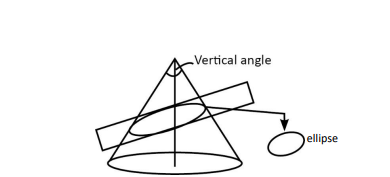
1.Curves obtained by cutting a double cone with a plane
5.1.Types of Conics
| Conic | Condition of Cutting Plane |
|---|---|
| Circle | Plane parallel to base |
| Parabola | Plane parallel to generator |
| Ellipse | Plane angled but < cone angle |
| Hyperbola | Plane parallel to axis |
- Right Circular Cone: Vertex O, axis (vertical), generator (slant), base.
- Sections:
- Circle: Plane || base.
- Parabola: Plane || generator.
- Ellipse: Plane angle > vertical angle but <90°.
- Hyperbola: Plane || axis (double cone).

6.Circle
6.1.Definition
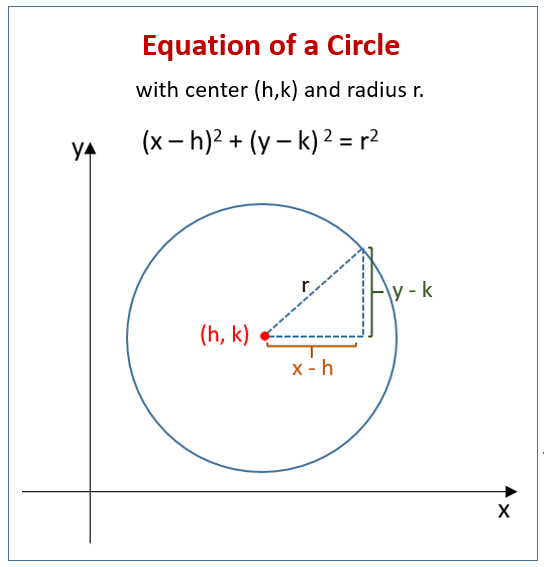
A circle is the locus of a point moving at a fixed distance r from a fixed centre.
6.2.Equations of Circle
1.Centre (0,0): x² + y² = r²
2.Centre (h,k): (x−h)² + (y−k)² = r²
3.General Form: x² + y² + 2gx + 2fy + c = 0
Centre = (−g,−f), radius = √(g² + f² − c)
6.3.Special Cases
1.Circle touches x-axis → centre (h,r)
2.Circle touches y-axis → centre (r,k)
3.Circle passes through origin → (x−a)² + (y−b)² = r²
4.Angle in semicircle = 90°
5.Four points on same circle → concyclic
7.Important Formulas
| S.N | Concept | Formula / Description |
|---|---|---|
| 1 | Distance between two points | AB = √[(x₂−x₁)² + (y₂−y₁)²] |
| 2 | Midpoint of two points | M = ((x₁+x₂)/2 , (y₁+y₂)/2) |
| 3 | Slope of a line | m = (y₂−y₁)/(x₂−x₁) |
| 4 | Condition for parallel lines | m₁ = m₂ |
| 5 | Condition for perpendicular lines | m₁ × m₂ = −1 |
| 6 | Centre of circle (general form) | Centre = (−g,−f) |
| 7 | Radius of circle (general form) | r = √(g² + f² − c) |
| 8 | Slope of line at angle θ | m = tanθ |
8.Important Questions
Question 1
Find the equation of the line passing through (2, 3) and parallel to
4x - 5y + 10 = 0.
Solution:
Given line: 4x - 5y + 10 = 0
Rewrite in slope form:
5y = 4x + 10
y = (4/5)x + 2
So slope m = 4/5
For a parallel line, slope remains same.
Using point-slope form:
y - 3 = (4/5)(x - 2)
Multiply both sides by 5:
5y - 15 = 4x - 8
Rearranging:
4x - 5y + 7 = 0
Question 2
Find the acute angle between the lines
3x - 4y + 5 = 0 and 4x + 3y - 1 = 0.
Solution:
First line:
3x - 4y + 5 = 0
4y = 3x + 5
y = (3/4)x + 5/4
So slope m1 = 3/4
Second line:
4x + 3y - 1 = 0
3y = -4x + 1
y = (-4/3)x + 1/3
So slope m2 = -4/3
Formula for angle between two lines:
tan(theta) = |(m1 - m2) / (1 + m1m2)|
Substitute values:
tan(theta) = |(3/4 + 4/3) / (1 - 1)|
Denominator becomes zero.
Therefore theta = 90 degrees.
So the acute angle between the lines is 90 degrees.
Question 3
Find the combined equation of the pair of lines
x - y = 0 and 2x + y = 0.
Solution:
Combined equation is product of both equations:
(x - y)(2x + y) = 0
Multiply:
2x squared + xy - 2xy - y squared = 0
Simplify:
2x squared - xy - y squared = 0
Question 4
Find the equation of the circle with centre (3, -2) and radius 5.
Solution:
Standard form of circle:
(x - h) squared + (y - k) squared = r squared
Here h = 3, k = -2, r = 5
Substitute:
(x - 3) squared + (y + 2) squared = 25
Expand:
x squared - 6x + 9 + y squared + 4y + 4 = 25
Rearrange:
x squared + y squared - 6x + 4y - 12 = 0
Question 5
Find the centre and radius of the circle
x squared + y squared + 4x - 6y - 12 = 0.
Solution:
Group x and y terms:
(x squared + 4x) + (y squared - 6y) = 12
Complete square:
(x + 2) squared - 4 + (y - 3) squared - 9 = 12
Add constants:
(x + 2) squared + (y - 3) squared = 25
So,
Centre = (-2, 3)
Radius = 5
MORE PRACTICE QUESTIONS (MODERATE TO COMPLEX)
Question 6
Find equation of the line passing through (1, -2) and perpendicular to
2x + 3y - 7 = 0.
Solution:
Given line:
2x + 3y - 7 = 0
3y = -2x + 7
y = (-2/3)x + 7/3
Slope of given line = -2/3
Slope of perpendicular line = 3/2
Using point-slope form:
y + 2 = (3/2)(x - 1)
Multiply by 2:
2y + 4 = 3x - 3
Rearrange:
3x - 2y - 7 = 0
Question 7
Find the angle between lines
x + y = 0 and x - y = 0.
Solution:
First line slope = -1
Second line slope = 1
tan(theta) = |(-1 - 1) / (1 - 1)|
Denominator zero.
So angle = 90 degrees.
Question 8
Find combined equation of pair of lines passing through origin and having slopes 2 and -3.
Solution:
General equation:
(y - 2x)(y + 3x) = 0
Multiply:
y squared + 3xy - 2xy - 6x squared = 0
Simplify:
y squared + xy - 6x squared = 0
Question 9
Find the equation of circle passing through (0,0) with centre on x-axis and radius 5.
Solution:
Let centre be (a, 0).
Using circle equation:
(x - a) squared + y squared = 25
Since circle passes through origin:
a squared = 25
So a = 5 or a = -5
Hence equations:
(x - 5) squared + y squared = 25
or
(x + 5) squared + y squared = 25
Question 10
Find equation of circle passing through points (1,0), (0,1), and (0,-1).
Solution:
General circle equation:
x squared + y squared + 2gx + 2fy + c = 0
Substitute points one by one.
For (1,0):
1 + 0 + 2g + c = 0
For (0,1):
1 + 2f + c = 0
For (0,-1):
1 - 2f + c = 0
Subtract last two equations:
4f = 0
So f = 0
Then c = -1
Then 2g = 0
So g = 0
Final equation:
x squared + y squared - 1 = 0
Visit this link for further practice!!
https://besidedegree.com/exam/s/academic