1. 3D Shapes Overview
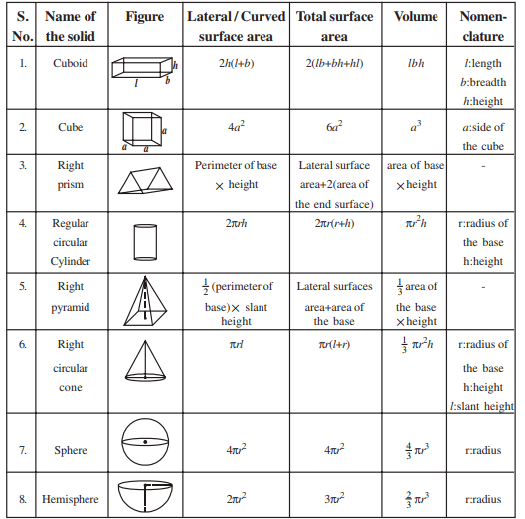
| Shape | Faces | Edges | Vertices | Notes |
|---|---|---|---|---|
| Cube | 6 square faces | 12 | 8 | All sides equal, LSA = 4a², TSA = 6a², Volume = a³ |
| Cuboid | 6 rectangular faces | 12 | 8 | LSA = 2h(l+b), TSA = 2(lb+bh+hl), Volume = l×b×h |
| Sphere | 1 curved surface | 0 | 0 | CSA = 4πr², Volume = 4/3πr³ |
| Hemisphere | 1 curved + 1 circular base | 0 | 0 | CSA = 2πr², TSA = 3πr², Volume = 2/3πr³ |
| Cylinder | 2 circular + 1 curved | 2 | 0 | CSA = 2πrh, TSA = 2πr(h+r), Volume = πr²h |
| Cone | 1 circular + 1 curved | 1 | 1 | Slant height l = √(r² + h²), CSA = πrl, TSA = πr(r+l), Volume = 1/3πr²h |
| Square Pyramid | 1 square + 4 triangles | 8 | 5 | LSA = 2al, TSA = a(a+2l), Volume = 1/3a²h |
| Triangular Pyramid | 4 triangular faces | 6 | 4 | V = 1/3 × base area × height |
| Prism (Rectangular/Triangular) | Rectangular + 2 bases | depends | depends | Volume = base area × height, TSA = sum of all faces |
Tips:
Check number of faces, edges, and vertices for tricky questions.
Know which faces are counted for TSA and which are joined for combined solids.
2. Square-Based Pyramid
Key Terms:
a = base side, h = vertical height, l = slant height, e = lateral edge
Base diagonal = a√2, Half diagonal = a√2 / 2
Relations:
l² = h² + (a/2)²
e² = h² + (a√2 /2)²
Formulas:
LSA = 2 a l
TSA = a² + 2 a l = a(a + 2 l)
Volume = 1/3 a² h
Important Questions:
Q1: a = 12 cm, l = 10 cm → TSA, h, V
TSA = 12(12 + 20) = 384 cm²
h = √(10² − 6²) = 8 cm
Volume = 1/3 × 144 × 8 = 384 cm³
Q2: TSA = 144 cm², l = 5 → a
a(a + 10) = 144 → a² + 10a − 144 = 0 → a = 8 cm
Q3: Volume = 384 cm³, a = 12 → h, l
h = 384×3 /144 = 8 cm
l = √(8² + 6²) = 10 cm
3. Cone
Key Terms: r = radius, h = height, l = slant height
Relations: l² = h² + r²
Formulas:
CSA = π r l
TSA = π r(r + l)
Volume = 1/3 π r² h
Important Questions:
Q4: r = 7, h = 24 → l, CSA, TSA, Volume
l = √(24² + 7²) = 25 cm
CSA = 3.14 × 7 × 25 ≈ 549.5 cm²
TSA = 3.14 × 7 × 32 ≈ 703 cm²
V = 1/3 × 3.14 × 49 × 24 ≈ 1231.7 cm³
Q5: TSA = 2816, r + l = 64 → r, l
r(64) = 896 → r = 14, l = 50
Q6: r:h = 5:12, V = 314.16 → r, h, l
r = 5, h = 12, l = 13
4. Cylinder
Formulas:
CSA = 2 π r h
TSA = 2 π r(h + r)
Volume = π r² h
Important Questions:
Q7: r = 7, h = 20 → CSA, TSA, V
CSA = 2 × 3.14 × 7 × 20 ≈ 879.2
TSA = 879.2 + 2 × 3.14 × 49 ≈ 1186.92
V = 3.14 × 49 × 20 ≈ 3077.2
Q8: V = 1540, r = 7 → h, TSA
h ≈ 10 cm, TSA ≈ 747.32
5. Combined Solids
Rules:
Volume → add all parts
TSA → exclude joined faces
Painting → only visible surfaces
Formulas:
Q9: Pencil r = 2, cylinder h = 10, cone h = 5
Cone slant: l = √(2² +5²) ≈ 5.385
Cylinder CSA = 125.6, Cone CSA ≈ 33.8, Base = 12.56
TSA ≈ 171.96, Volume ≈ 146.53
Q10: Ice-cream cone r = 7, cone h = 12, hemisphere r = 7
l = √(12² +7²) ≈ 13.89
Cone CSA ≈ 304.4, Hemisphere ≈ 307.72
TSA ≈ 612.12, Volume ≈ 1334.13
Q11: Two cones joined, r = 3, h₁ = 8, h₂ = 12
l₁ = 8.54, l₂ = 12.37
LSA = π r (l₁ + l₂) ≈ 197
V = 1/3 π r² (8 +12) ≈ 188.4
6. Sphere & Hemisphere
Sphere:
CSA = 4 π r²
Volume = 4/3 π r³
Hemisphere:
CSA = 2 π r², TSA = 3 π r²
Volume = 2/3 π r³
Tip: Hemisphere’s curved surface is half of a sphere; TSA includes base.
7. Real-Life Applications
Water tanks → V × 1000 = litres
Fencing → perimeter × rounds
Painting → visible area only
Bricks/Tiles → Total area ÷ area per brick
Golden Rules:
Pyramid → 1/3 a² h, TSA = a(a+2l)
Cone → l = √(h²+r²), TSA = π r(r+l)
Cylinder → CSA = 2 π r h, TSA = 2 π r(h+r)
Combined solids → add volumes, subtract internal faces
Always solve stepwise: find dimensions first, then area/volume
Important questions for practice
1. Square-Based Pyramid
Q1: Base side a = 12 cm, slant height l = 10 cm. Find TSA, Volume, and height h.
Solution:
TSA:
TSA = a(a + 2l)
TSA = 12(12 + 20)
TSA = 12 × 32
TSA = 384 cm²
Height:
l² = h² + (a/2)²
10² = h² + 6²
100 = h² + 36
h² = 64
h = 8 cm
Volume:
V = 1/3 × a² × h
V = 1/3 × 144 × 8
V = 384 cm³
Q2: TSA = 144 cm², slant height l = 5 cm. Find base side a.
Solution:
TSA = a(a + 2l)
144 = a(a + 10)
a² + 10a − 144 = 0
Solve quadratic:
a = 8 cm (positive root)
Q3: Volume = 384 cm³, base a = 12 cm. Find height h and slant height l.
Solution:
Volume formula:
V = 1/3 × a² × h
384 = 1/3 × 144 × h
h = 8 cm
Slant height:
l² = h² + (a/2)²
l² = 8² + 6²
l² = 64 + 36
l = 10 cm
2. Cone
Q4: Radius r = 7 cm, height h = 24 cm. Find slant height, CSA, TSA, Volume.
Solution:
Slant height:
l = √(h² + r²)
l = √(24² + 7²)
l = √625
l = 25 cm
CSA:
CSA = π r l
CSA = 3.14 × 7 × 25
CSA ≈ 549.5 cm²
TSA:
TSA = π r (r + l)
TSA = 3.14 × 7 × 32
TSA ≈ 703 cm²
Volume:
V = 1/3 π r² h
V = 1/3 × 3.14 × 49 × 24
V ≈ 1231.7 cm³
Q5: TSA = 2816 cm², r + l = 64 cm. Find r and l.
Solution:
TSA = π r (r + l)
3.14 r × 64 = 2816
r × 64 = 896
r = 14 cm
l = 64 − r
l = 50 cm
Q6: Ratio r:h = 5:12, Volume = 314.16 cm³. Find r, h, l.
Solution:
Let r = 5x, h = 12x
Volume:
V = 1/3 π r² h
314.16 = 1/3 × 3.14 × (25x²) × 12x
314.16 ≈ 314 x³
x ≈ 1
r = 5 cm, h = 12 cm
Slant height:
l = √(r² + h²)
l = √(25 + 144)
l = √169
l = 13 cm
3. Cylinder
Q7: Cylinder r = 7 cm, h = 20 cm. Find CSA, TSA, Volume.
Solution:
CSA = 2 π r h
CSA = 2 × 3.14 × 7 × 20
CSA ≈ 879.2 cm²
TSA = CSA + 2 π r²
TSA = 879.2 + 2 × 3.14 × 49
TSA ≈ 1186.92 cm²
Volume:
V = π r² h
V = 3.14 × 49 × 20
V ≈ 3077.2 cm³
Q8: Volume = 1540 cm³, r = 7 cm. Find height h and TSA.
Solution:
Volume formula:
V = π r² h
1540 = 3.14 × 49 × h
h ≈ 10 cm
CSA = 2 π r h
CSA = 2 × 3.14 × 7 × 10
CSA ≈ 439.6 cm²
TSA = CSA + 2 π r²
TSA = 439.6 + 2 × 3.14 × 49
TSA ≈ 747.32 cm²
4. Combined Solids
Q9: Pencil: Cylinder r = 2 cm, h = 10 cm; Cone height = 5 cm. Find TSA, Volume.
Solution:
Cone slant height:
l = √(r² + h²)
l = √(4 + 25)
l ≈ 5.385 cm
Cylinder CSA:
2 π r h = 2 × 3.14 × 2 × 10
≈ 125.6 cm²
Cone CSA:
π r l = 3.14 × 2 × 5.385
≈ 33.8 cm²
Base area:
π r² = 3.14 × 4
≈ 12.56 cm²
TSA = 125.6 + 33.8 + 12.56
≈ 171.96 cm²
Volume:
Cylinder = π r² h = 3.14 × 4 × 10 ≈ 125.6 cm³
Cone = 1/3 π r² h = 1/3 × 3.14 × 4 × 5 ≈ 20.93 cm³
Total Volume ≈ 146.53 cm³
Q10: Ice-cream cone: r = 7 cm, cone h = 12 cm, hemisphere r = 7 cm. Find TSA, Volume.
Solution:
Cone slant height:
l = √(h² + r²) = √(144 + 49) ≈ 13.89 cm
Cone CSA = π r l = 3.14 × 7 × 13.89 ≈ 304.4 cm²
Hemisphere surface = 2 π r² = 2 × 3.14 × 49 ≈ 307.72 cm²
TSA = 304.4 + 307.72 ≈ 612.12 cm²
Volume:
Cone = 1/3 π r² h = 1/3 × 3.14 × 49 × 12 ≈ 615.36 cm³
Hemisphere = 2/3 π r³ = 2/3 × 3.14 × 343 ≈ 718.77 cm³
Total Volume ≈ 1334.13 cm³
Q11: Two cones joined at base, r = 3 cm, heights = 8 cm and 12 cm. Find Volume and TSA.
Solution:
Volume = 1/3 π r² (h1 + h2)
= 1/3 × 3.14 × 9 × 20
≈ 188.4 cm³
Slant heights:
l1 = √(3² + 8²) ≈ 8.54 cm
l2 = √(3² + 12²) ≈ 12.37 cm
LSA = π r (l1 + l2)
= 3.14 × 3 × (8.54 + 12.37)
≈ 197 cm²
Visit this link for further practice!!